
Analytics full events export
Overview
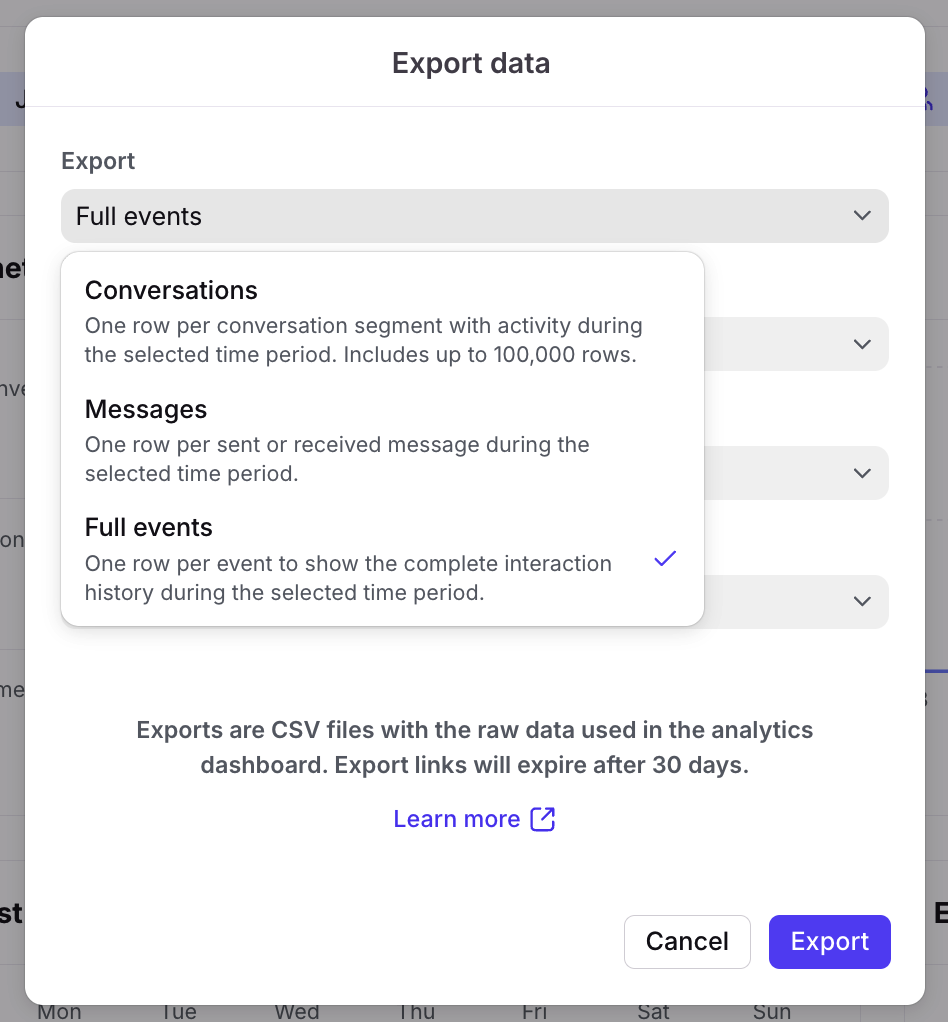
The Full events export is one the export types when you export an analytics report.
The exported file contains one line for each activity that occurred and its corresponding details for the selected date range.
All timestamps in the file are formatted as YYYY-MM-DD HH:mm:ss, in the requested user's time zone. Information provided reflects the conversation segment data at the time the export was generated.
Exported events
Full events exports include the following activities:
Inbound
Outbound
Outbound reply (outbound message that is a reply)
Archive / Reopen
Reminder
Trash / Restore
Assign / Unassign
Tag / Untag
Move
Comment
Mention
Snooze
Exported fields
Activity ID: Internal Front ID of the activity.
Type: Describes what activity occurred (see list above).
Source: Where is the activity coming from.
Message ID*: Internal Front ID of the message.
Segment ID: Represents a conversation segment, by concatenating the conversation ID and segment number. This is the basis for the calculation of all segment-level metrics.
Conversation ID*: Internal Front ID of the conversation.
Ticket IDs: Ticket IDs attached to the conversation at the time the activity was recorded.
Segment: Segment of the conversation.
Segment start: The date and time of the first activity for any new segment.
Segment end:
If segment is currently open: The date and time the segment is expected to close (moved to inactive state). This date can change if additional activities are added to the segment.
If segment is closed: The date and time the segment closed.
Direction: Inbound or Outbound.
Status: Current status of the conversation: Archived or Open.
Status at activity time: Status of the conversation immediately after the activity was recorded. If a conversation was originally Open and the activity is Archived, the status at activity time would read Archived.
Inbox: Name of the inbox where the message currently lives. If the message appeared in multiple inboxes, the activity will appear one time for each inbox value.
Inbox API ID: External Front ID of the inbox.
Inbox at activity time: List of inboxes where the message lived immediately after the activity was recorded. If the message appeared in multiple inboxes, the activity will appear one time for each inbox value. If the activity represents a move from one inbox to another, the ending inbox is recorded.
Inbox API IDs at activity time: External Front IDs for the list of inboxes where the message lived immediately after the activity was recorded.
Previous inbox IDs: External Front IDs for the list of inboxes where the message lived prior to when the activity was recorded.
Message date: Represents the date of an activity, not only messages. The date range filter is tied to this field. Formatted as YYYY-MM-DD HH:mm:ss, in the requested user's time zone.
Autoreply: Indicates whether this message is an automated reply, 1 is yes, 0 is no.
Reaction time: Time (in seconds) taken to assign/reassign the first inbound message to another teammate (not to self), send a reply, or archive.
Total reply time: Duration (in seconds) that a contact was kept waiting for a reply from the team during a conversation segment. This is the sum of all response times over the segment - period since the first inbound to the last reply that's a resolution.
Handle time: Duration (in seconds) between clicking and viewing the conversation and sending a reply.
Response time: Duration (in seconds) between the first inbound message and the next outbound message in the same conversation. Corresponds to Reply time in analytics reports.
Ticket resolution time: Average time (in seconds) from the start of a conversation segment to the last resolution. Data is only available for conversations in inboxes with ticketing enabled. The legacy Stage resolution time metric is available in the API.
Ticket replies to resolution: Average number of outbound replies for resolved conversation segments. Data is only available for conversations in inboxes with ticketing enabled. The legacy Replies to resolution metric is available in the API.
Attributed to: [Legacy] Previous export attribution field. Superseded by Attributed teammates.
Assignee: Username of the teammate who was the assignee for this conversation.
Author: Username of the teammate who replied to the email.
Contact name: Contact's first and last name.
Contact handle: Contact's email address, twitter handle, or phone number (depending on the source of the message).
Account names: Account the contact is linked to. Accounts are not retroactively applied to existing messages.
From: Email address of the sender.
To: Email address of the recipient.
Cc: Email address of those CC'ed on the email.
Bcc: Email address of those BCC'ed on the email.
Extract: Sample of the message body (200 character limit).
Tags: Tags currently attached to the conversation.
Tag API IDs: External Front IDs of the tags attached to the conversation.
Tags at activity time: Tags attached to the conversation at the time the activity was recorded.
Tag API IDs at activity time: External Front IDs for the tags attached to the conversation at the time the activity was recorded.
Tag application duration: How long a tag was applied to a conversation before being untagged.
Activity API ID: External Front ID of the activity.
Message API ID: External Front ID of the message.
Comment API ID: External Front ID of the comment.
Conversation API ID: External Front ID of the conversation.
Message original ID: Message-id as defined in the email headers of a message (email only).
New conversation: Indicates whether this event is the first of a new conversation or segment, 1 is yes, 0 is no.
First response: Indicates whether this message is the first reply to a new inbound conversation or segment, 1 is yes, 0 is no.
Business hours: Indicates whether the message occurred within business hours, 1 is yes, 0 is no.
Subject: Subject of the conversation.
Account name: Account linked to the contact who provided the CSAT rating. Accounts are not retroactively applied to existing CSAT ratings.
Survey rating: The CSAT rating selected by the contact.
Survey comment: The CSAT comment provided by the contact.
Segment closed†: Indicates whether the segment is currently closed, 1 is yes, 0 is no.
Segment contains messages†: Indicates whether the segment currently contains messages, 1 is yes, 0 is no.
Last segment activity†: Date and time of the latest activity recorded on this segment.
Added tag: Name of the tag added by the Tag event
Added tag API ID: External Front ID for the tag added by the Tag event
Removed tag: Name of the tag removed by the Untag event
Removed tag API ID: External Front ID for the tag removed by the Untag event
Segment cumulative teammates: List of usernames of all teammates that were assigned or took action (including through personal rules) during the conversation segment.
Ticket status name: Current ticket status applied to the conversation.
Ticket status name at activity time: Ticket status applied to the conversation at the time the activity was recorded.
Ticket status category: Current ticket status category applied to the conversation - Open, Waiting, or Resolved.
Attributed teammates: Usernames of the teammate(s) credited for the activity, including AI agents when applicable. Can include more than one teammate (for example, all contributors on a multi-teammate CSAT response). If nobody is credited, falls back to the teammate who triggered the activity, for example who archived, assigned, tagged, or commented when that action has no analytics credit.
Ticket status category at activity time: Ticket status category applied to the conversation at the time the activity was recorded - Open, Waiting, or Resolved.
Time spent in "Open": Total duration (in milliseconds) that the conversation spent in the default Open ticket status.
Transitions to "Open": Count of times the conversation’s ticket status was changed to the default Open status from another status.
Time spent in "Waiting": Total duration (in milliseconds) that the conversation spent in the default Waiting ticket status.
Transitions to "Waiting": Count of times the conversation’s ticket status was changed to the default Waiting status from another status.
Time spent in "Resolved": Total duration (in milliseconds) that the conversation spent in the default Resolved ticket status.
Transitions to "Resolved": Count of times the conversation’s ticket status was changed to the default Resolved status from another status.
Time spent in [custom ticket status]: Total duration (in milliseconds) that the conversation spent in a specific custom ticket status. Each custom ticket status has its own column.
Transitions to [custom ticket status]: Count of times the conversation’s ticket status was changed to the specific custom ticket status from another status. Each custom ticket status has its own column.
Smart QA score: [criteria name]: Smart QA score applied to the conversation for the specified criteria. Each criteria has its own column. Only default criteria are supported. Custom criteria are not currently supported, but will be available in a future update.
Custom field: [conversation custom field name]‡: Current value for the conversation custom field. Each custom field has its own column.
Updated custom field: [conversation custom field name]‡: Edited value for the conversation custom field at the time the activity was recorded. Each custom field has its own column. Only has a value if the field was edited at the activity time.
*These columns in the export may be phased out in the future, as they are the Front analytics system's internal identifiers and should pose no impact to customers.
† Data is not available for conversation segments closed before Jan 19, 2023.
‡ Data is not available for conversation segments closed before early Feb 2026.
FAQ
How do "Attributed to" and "Attributed teammates" differ?
The export now more accurately identifies the teammate responsible for an activity. The "Attributed teammates" column in the export file clearly indicates whether an activity was generated by Autopilot, which was previously left blank in the legacy "Attributed to" column.
This enhancement improves the accuracy of exports, allowing administrators to seamlessly compare and analyze Autopilot activities alongside human teammate actions.
Example scenarios and export values:
Scenario | Attributed to (legacy) | Attributed teammates |
Autopilot reply via a rule | Often blank (shared rules); private rule may show the owner | front_ai_autopilot |
Smart QA: Reviewer R evaluates teammate E | R, or blank if rule-triggered | E |
Archive / assign / tag / comment actions | T | T (fallback) |
CSAT credited to A and B | Last responder only | A, B |
Outbound: Human A triggers, Human B sends | A | B |
Pricing
This feature is available on the latest Professional plan or above. Some legacy plans may also allow access to this feature.