
Smart QA
Overview
Front’s Smart QA (quality assurance) feature accelerates time-consuming manual QA processes with AI, giving support leaders a complete view of agent performance, without the need for manual ticket-by-ticket reviews. Configure your scorecard to automatically score the selected criteria, and display them in the plugin panel for email conversations.
Leverage Smart QA to improve team performance and ensure a consistently high-quality customer experience. AI-generated information for agent performance is provided as guidance for your own decision-making.
Please note the following:
Please rely on your own assessment and analysis or that of experts for significant decisions.
Please inform your agents or other End Users when you are applying Smart QA to their conversations.
Check out our Front Academy course here to learn more about leveraging value from Smart QA.
How it works
The Smart QA workflow in Front is as follows:
Set up scorecard criteria in the Front AI tab in workspace settings
Create a rule using the Review conversations with Smart QA rule template
Select conversation type(s)
Select shared inboxes
Select time period to trigger rule
Review QA results in conversation plugin panel or analytics
Scoring criteria
AI automatically scores conversations on the following criteria:
Default criteria
Category | Criteria | Description |
Communication | Brevity | The efficiency and conciseness of the agent's communication — providing necessary information without jargon, redundancy, or irrelevant detail. |
Empathy | How effectively the agent acknowledged and validated the customer's expressed emotions or difficult situation. Applicable when the customer explicitly expresses emotions or has a challenging situation. Variants:
| |
Friendliness | How effectively the agent conveyed warmth, friendliness, and a personable approach through positive language, enhancing the overall experience. | |
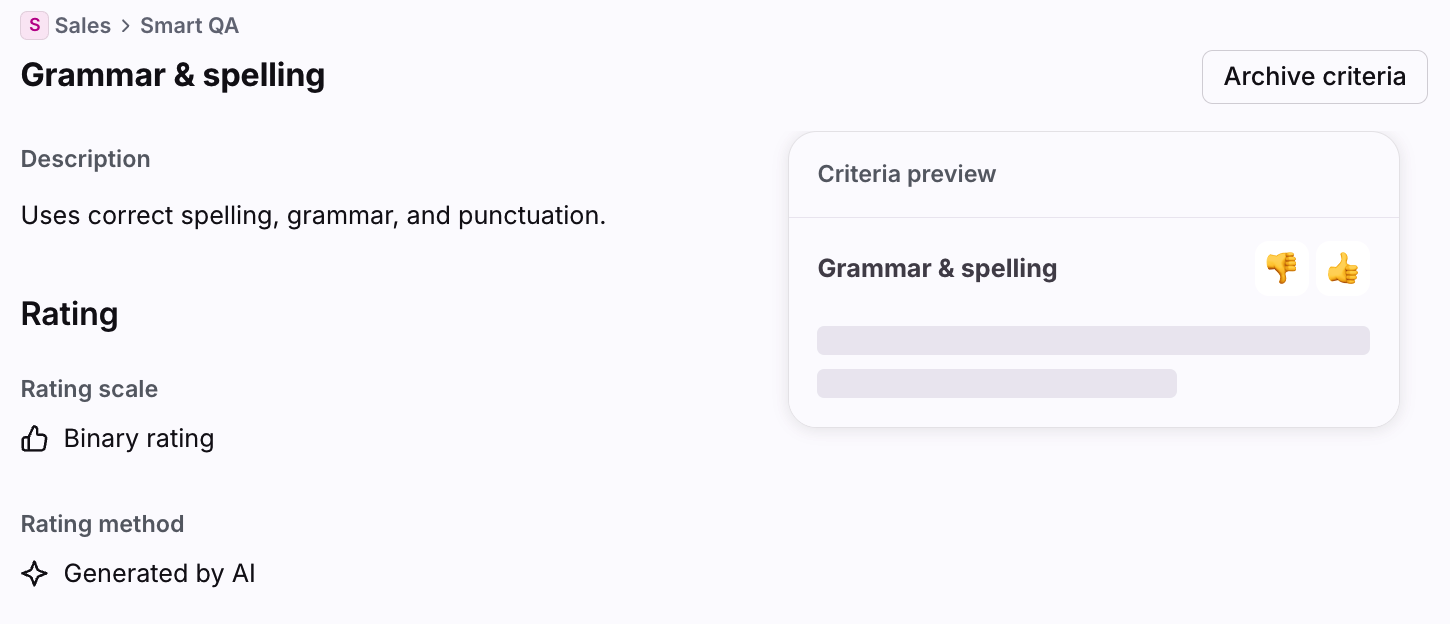
Grammar & spelling | The grammatical accuracy, spelling, punctuation, and syntax of the agent's written communication. Impacts clarity, credibility, and professionalism. | |
Greeting offered (Conversation opening) | How effectively the agent opened the conversation with a warm, welcoming, and contextually appropriate greeting that set a positive tone from the outset. | |
Information gathering | How effectively the agent asked relevant, targeted questions to fully understand the customer's issue — without asking for redundant information. Applicable when the initial query lacks sufficient detail. | |
Personalization | How effectively the agent tailored communication to the customer's specific situation, history, needs, or preferences using available context. Applicable when the agent had clear opportunities and available context to personalise responses. | |
Professionalism | How consistently the agent maintained courtesy, respect, and appropriate formality throughout the interaction, fostering credibility and trust. | |
Readability | The clarity, logical structure, and organization of the agent's messages, including effective use of formatting to aid comprehension. | |
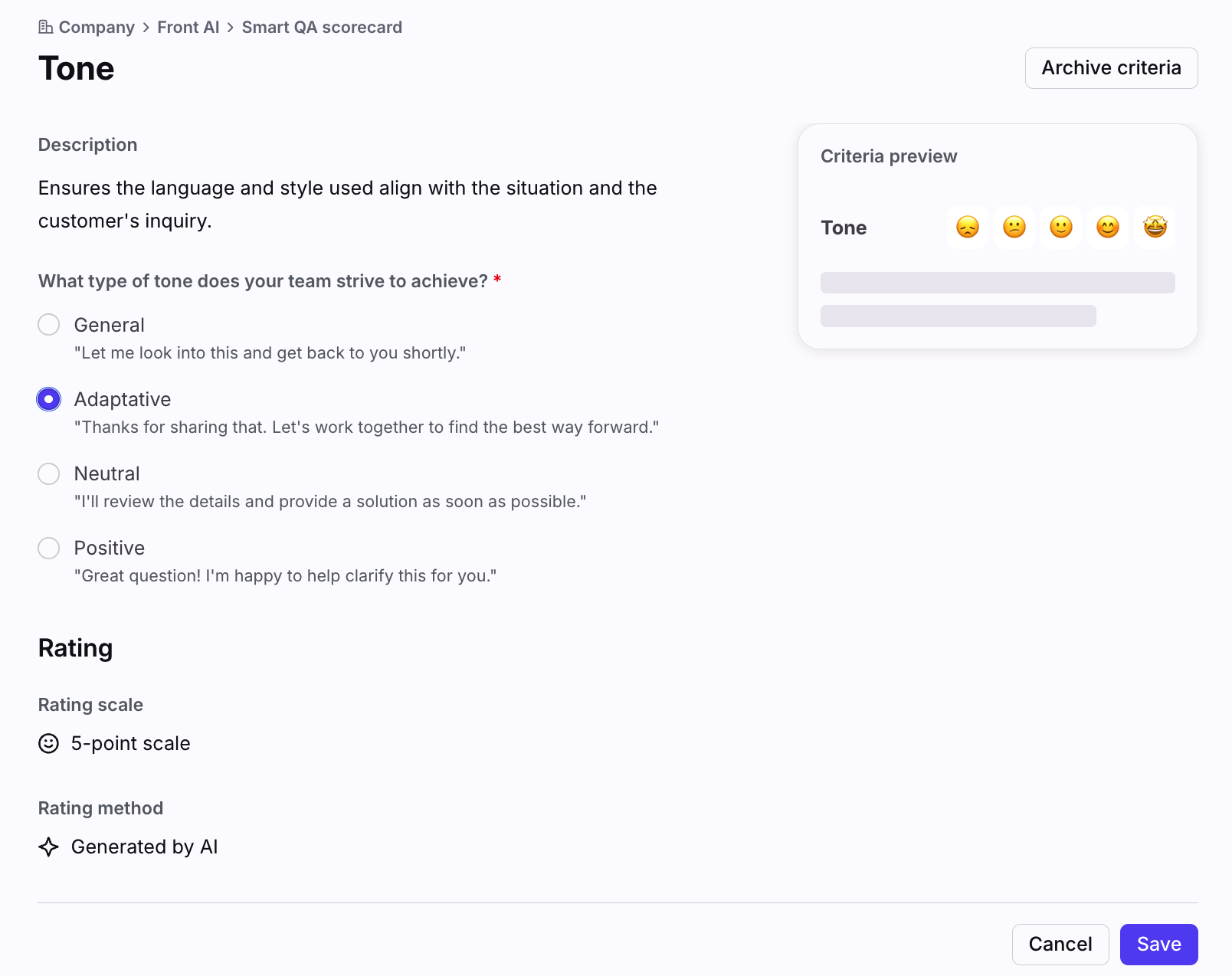
Tone | Whether the agent's overall tone suited the situation and positively supported the customer's experience — beyond basic politeness. Applicable when tone significantly impacts the customer experience. Variants:
| |
Solution | Comprehension | How well the agent grasps, reflects, and acknowledges the customer's issue and underlying needs — including when a requested solution isn't feasible. |
Solution offered | The clarity, thoroughness, and actionability of the agent's explanation of the solution or next steps, including verification of customer understanding. Applicable when the customers query requires resolution or defined next steps | |
Proactivity | Adaptability | How effectively the agent adjusted their style, pacing, technical depth, or approach in response to customer cues — demonstrating flexibility throughout. Applicable when the customer exhibited changes in mood, communication, or understanding suggesting the initial approach wasn't working. |
Demo offered | Whether the agent proactively offered a relevant demonstration or visual aid to clarify a complex process or feature difficult to convey through text alone. Applicable when the subject matter arose that would benefit significantly from a demo. | |
Upsell | How effectively the agent identified and communicated a relevant upsell or cross-sell opportunity, aligned with the customer's needs and presented appropriately. Applicable when a clear opportunity to upsell/cross-sell arose. |
Custom criteria
Create your own custom criteria. See below to learn more.
Rating scales
Smart QA has two rating scales to score criteria, a range (1-5) and binary (0 or 1).
On a range scale, criteria scores are normalized to a 0-1 scale as follows:
1 → 0
2 → 0.25
3 → 0.5
4 → 0.75
5 → 1
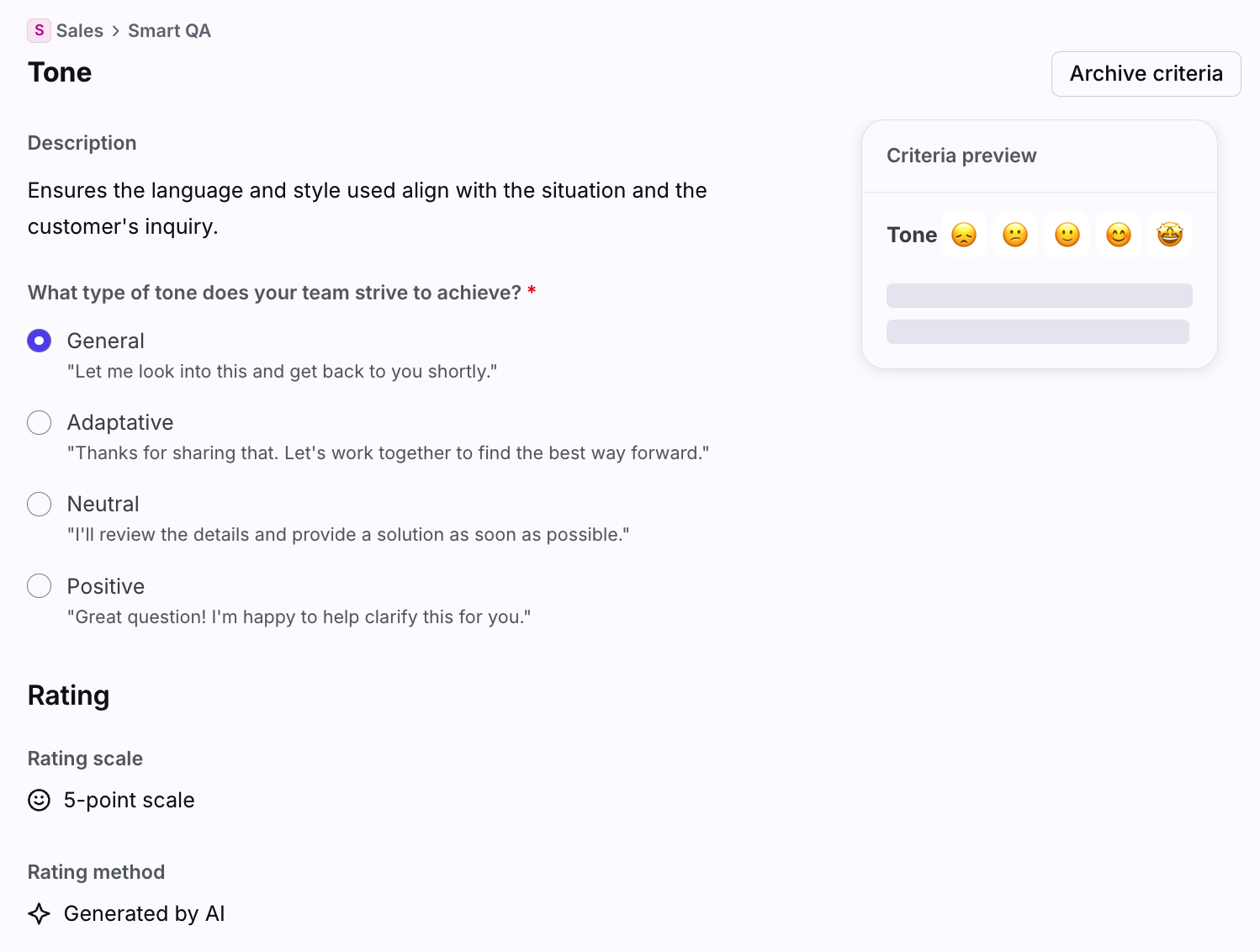
On a binary scale, criteria are scored either 0 or 1.
Score calculation
In the Smart QA analytics report, agents will have an average score for each criteria on your scorecard. N/A values are not factored into any scoring.
Example score calculation:
When looking at the Tone score for an agent, they received a 1/5 on the first conversation and a 4/5 on a second conversation.
The two scores are aggregated together. The formula used is: 0% (1/5) + 75% (4/5) → (0%+75%) / 2 = 37.5% → 38% by rounding.
The 38% score is shown in the Tone field in the analytics report for those two conversations.
Setting up scorecard criteria and rules
Step 1
Click the gear icon, then navigate to your workspace settings.
Step 2
Click Front AI in the left sidebar, then select the Smart QA tab at the top.
Step 3
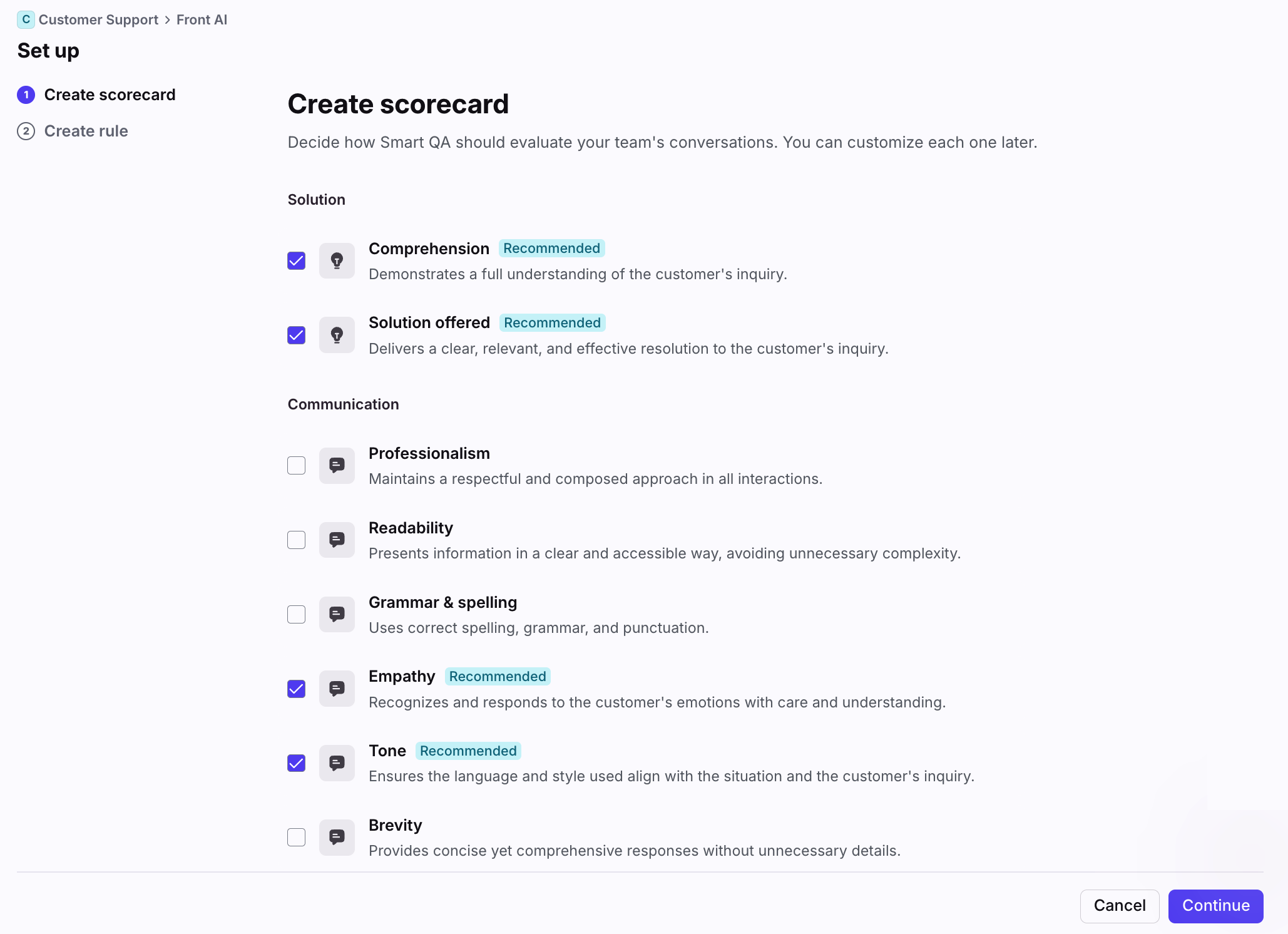
Click Start setup. You’ll see a list of criteria you can add to your scorecard. Select the ones you’d like to add, then click Continue.
Step 4
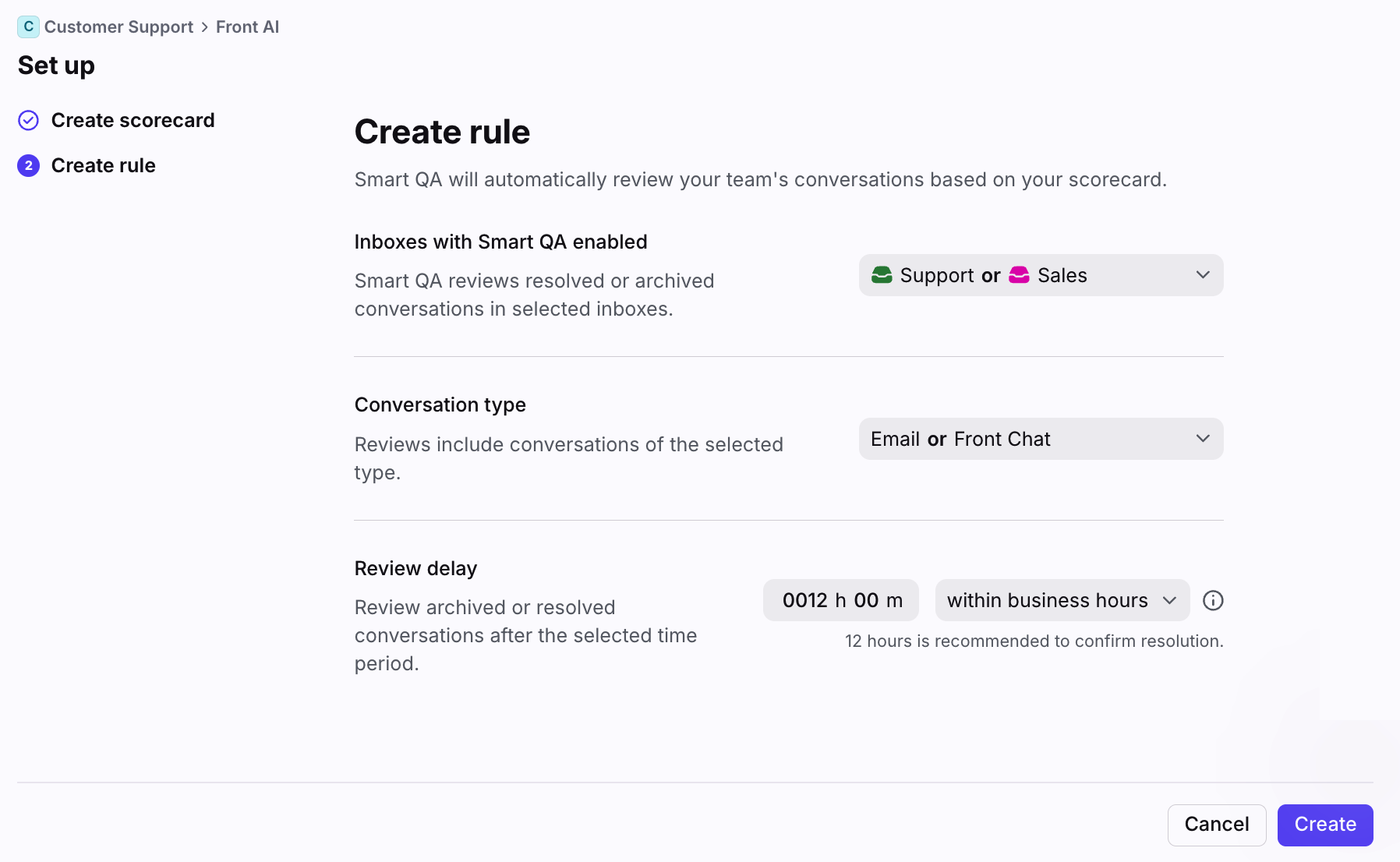
Fill in the following fields to create your Smart QA rule:
Inboxes with Smart QA enabled: Select the shared inboxes you want Smart QA to apply to
Conversation type: Select the conversation types you want Smart QA to apply to
Review delay: Enter the time Smart QA should wait before reviewing a conversation after it has been archived or resolved
Step 5
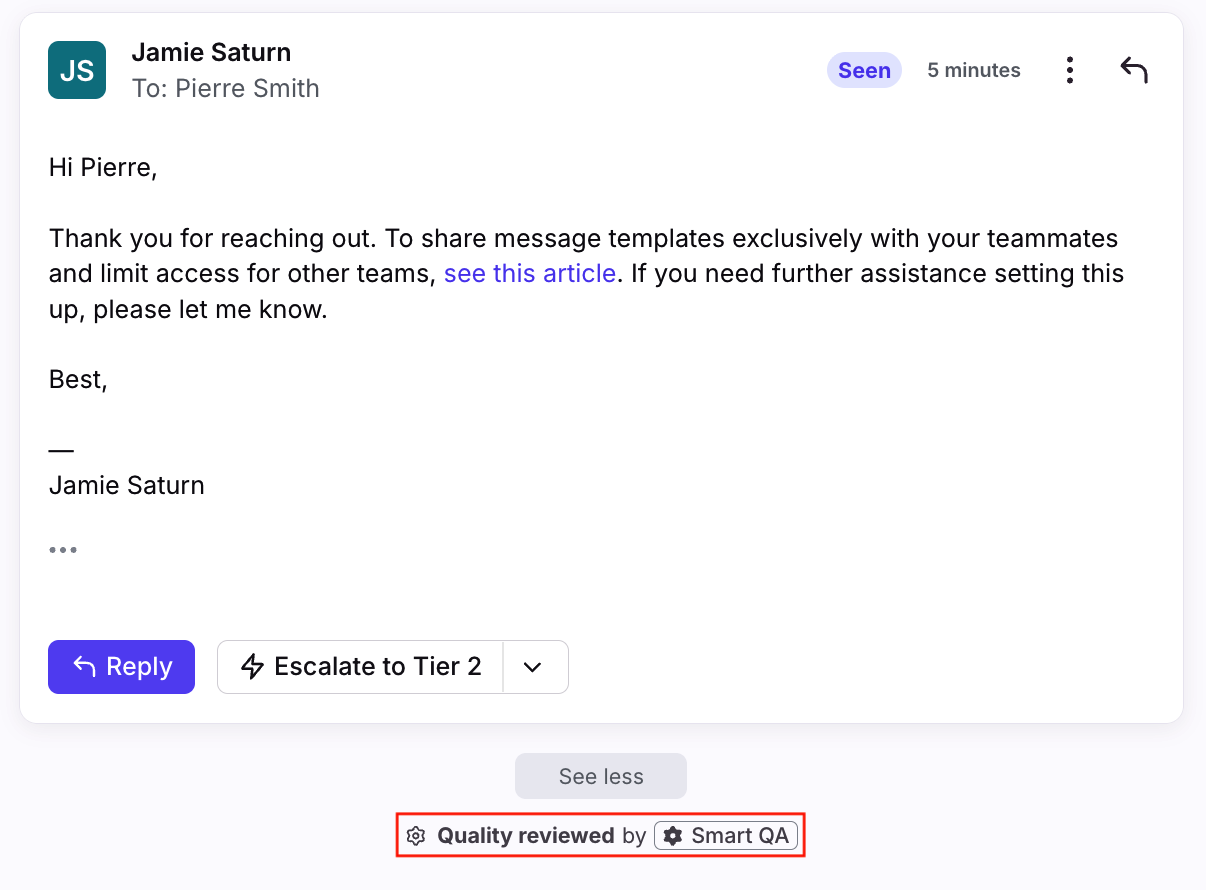
Click Create to finish. When QA is completed on a conversation, you’ll see the action in the conversation’s activity history.
Custom scorecard criteria
Create custom criteria for your scorecard to tailor Smart QA to your team’s specific quality criteria and business processes. You can create custom criteria after the initial Smart QA setup.
Criteria evaluates based upon the teammate’s messages and uses all other messages sent as additional context to inform the evaluation. Conversation metadata such as tags, timestamps and routing are not datapoints available for evaluation.
Step 1
Click the gear icon, navigate to your workspace settings, then select Front AI in the sidebar.
Step 2
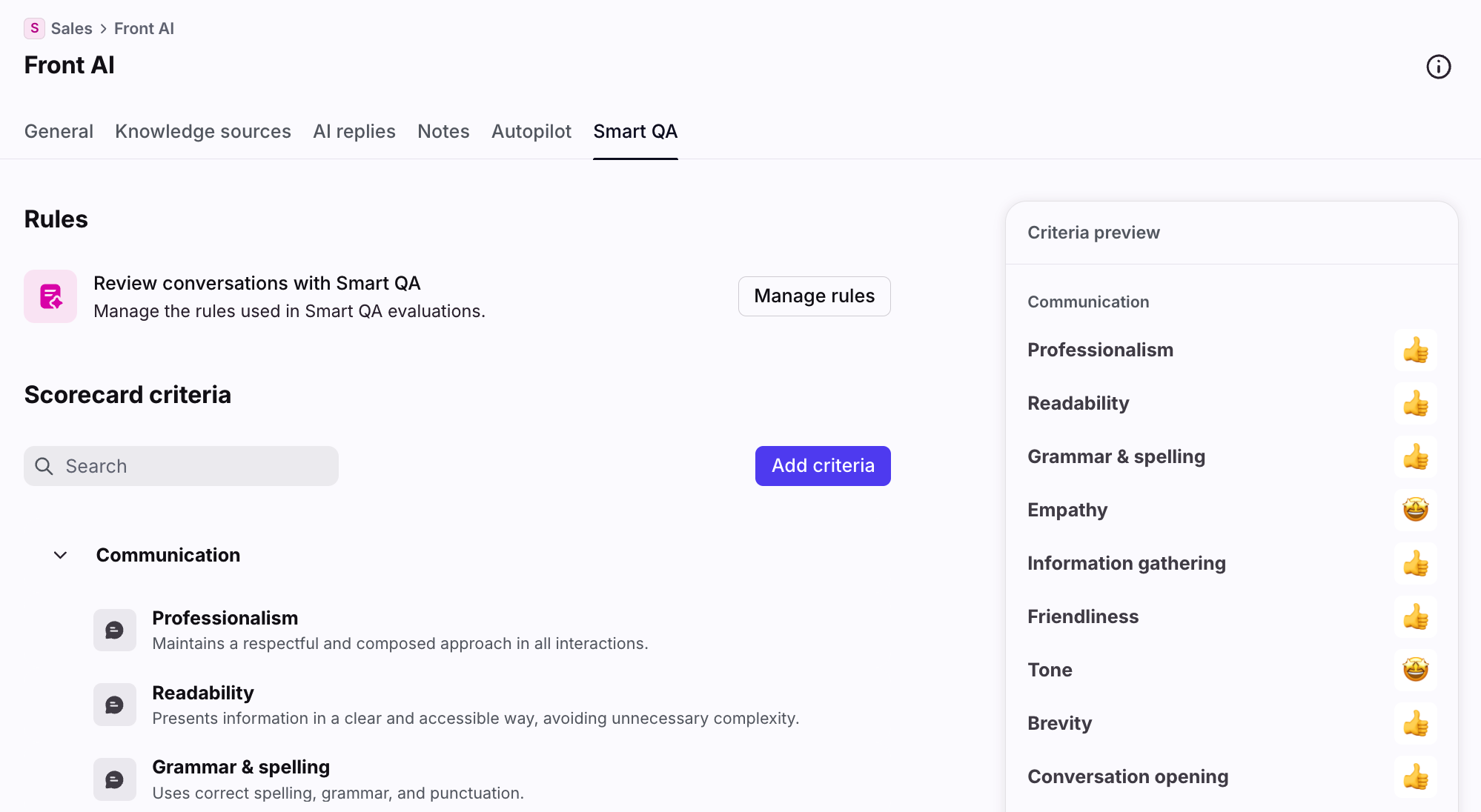
Select the Smart QA tab, then click Add criteria.
Step 3
In the pop-up, navigate to the Custom section and select Create criteria.
Step 4
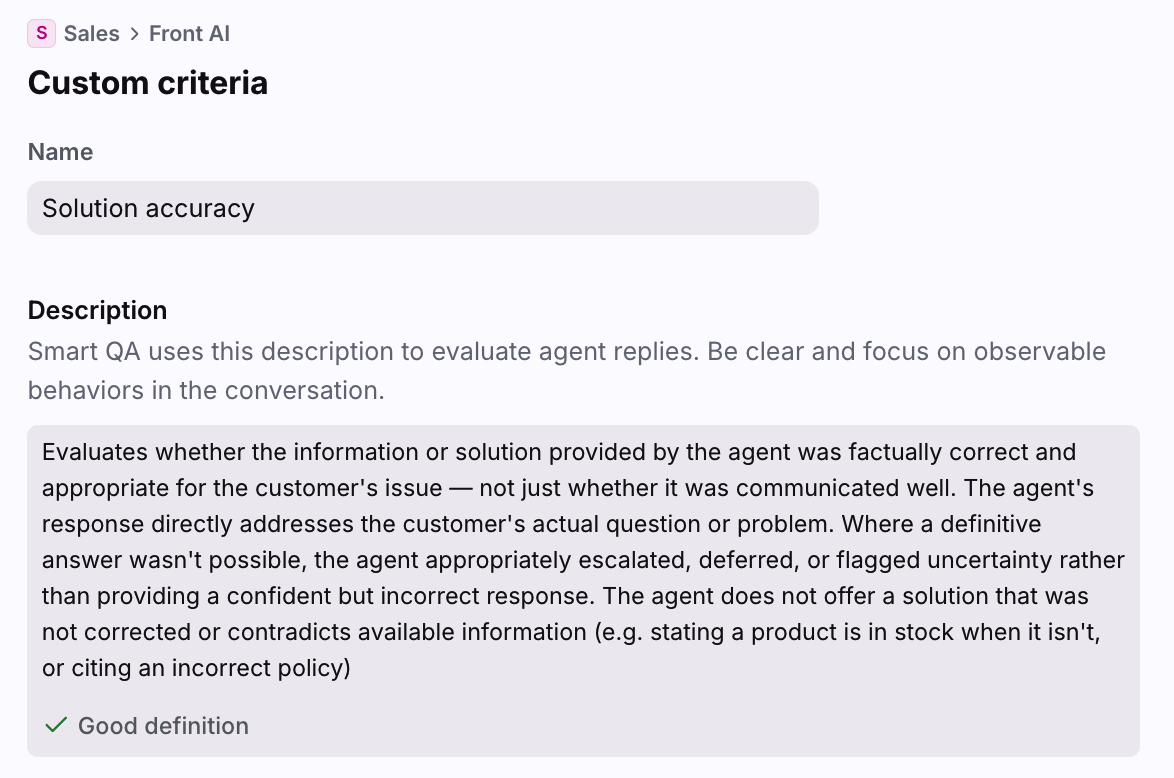
Give your criteria a name, then explain how Smart QA should evaluate the criteria in the Description field. For the best results, we recommend describing what the criteria assesses, what it does not assess, and formatting as natural language.
In this example, we’ll create a custom criteria named “Solution accuracy”.
Step 5
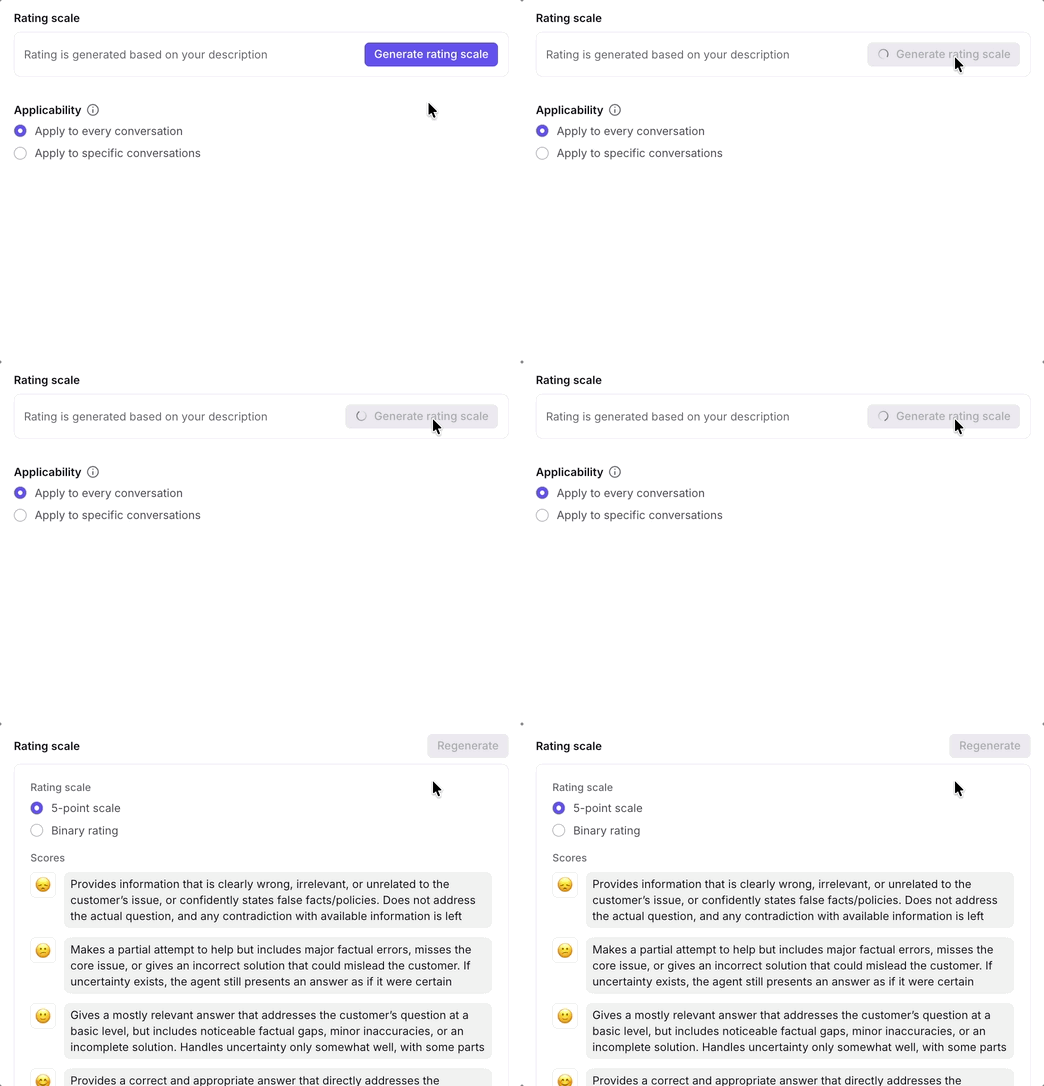
In the Rating scale section, click Generate rating scale to create a rating scale based on your description. From here you can:
Select whether you’d like to use a 5-point scale or binary rating
Manually adjust the language in the rating scale
You can also regenerate the scoring text at any time if you update the description of your criteria.
Step 6
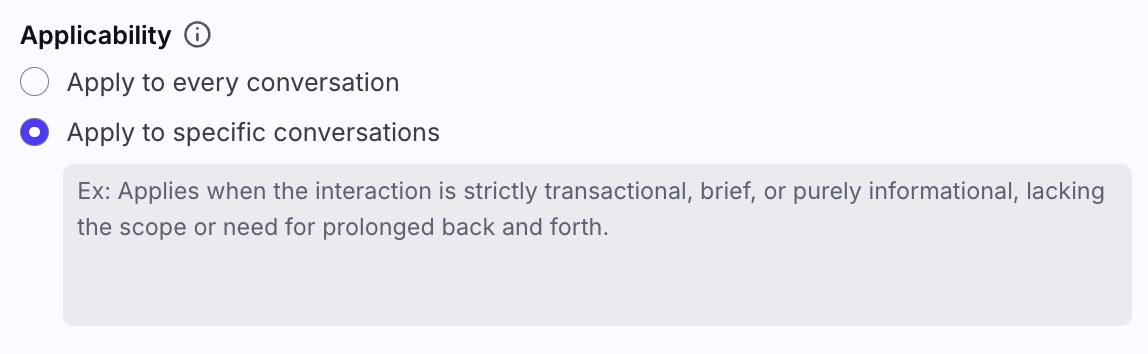
In the Applicability section, choose whether the criteria applies to every conversation, or specific conversations. If you select Apply to specific conversations, use the text box to explain the scenario when the criteria applies.
Step 7
Click Create. Your new criteria will now apply to conversations moving forward.
Editing scorecard criteria or rules
Step 1
Click the gear icon, then navigate to your workspace settings.
Step 2
Click Front AI in the left sidebar, then select the Smart QA tab at the top.
Step 3
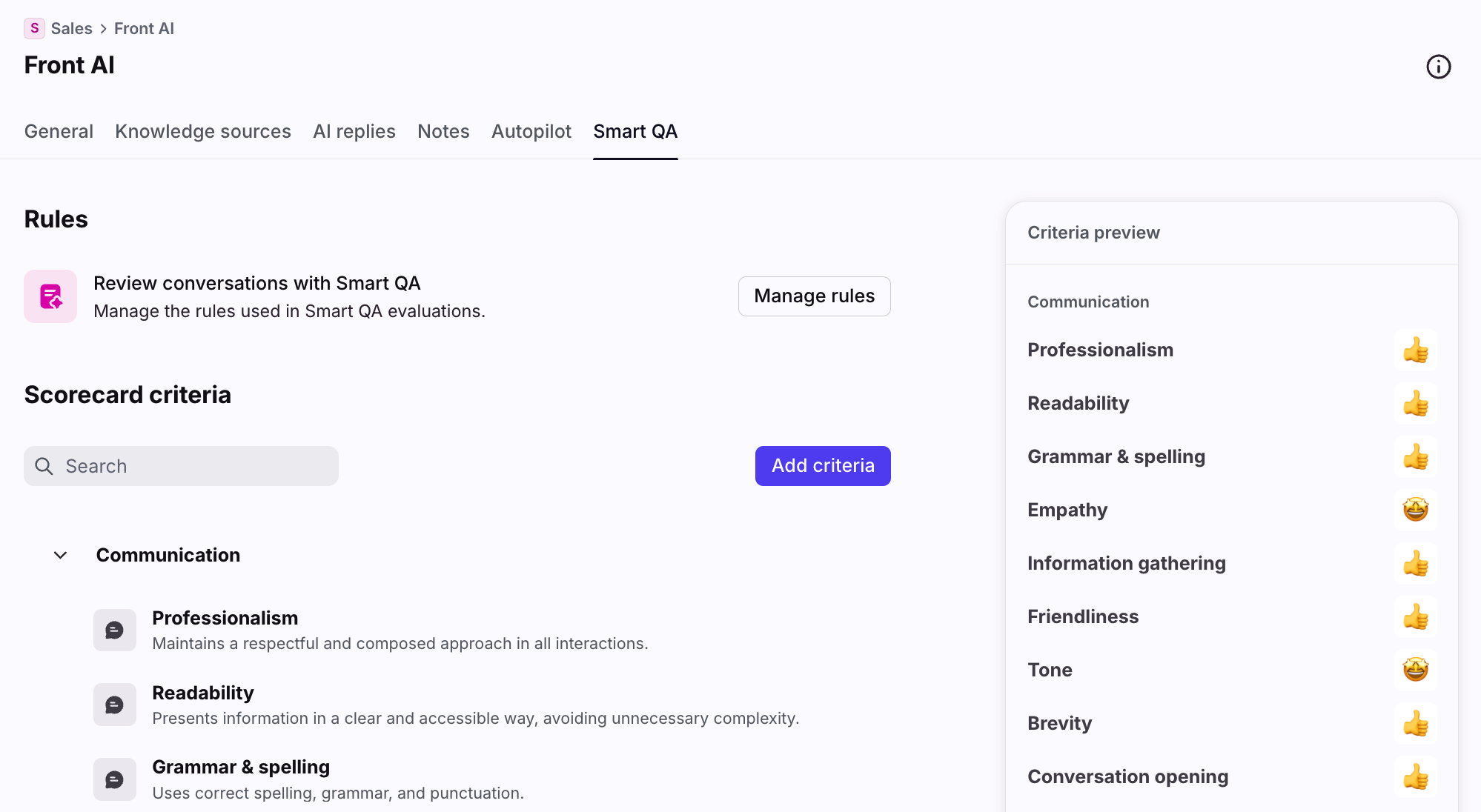
Click Manage rules to edit your Smart QA rule, click Add criteria to add criteria to your scorecard, or click an existing criteria to edit it.
Step 4
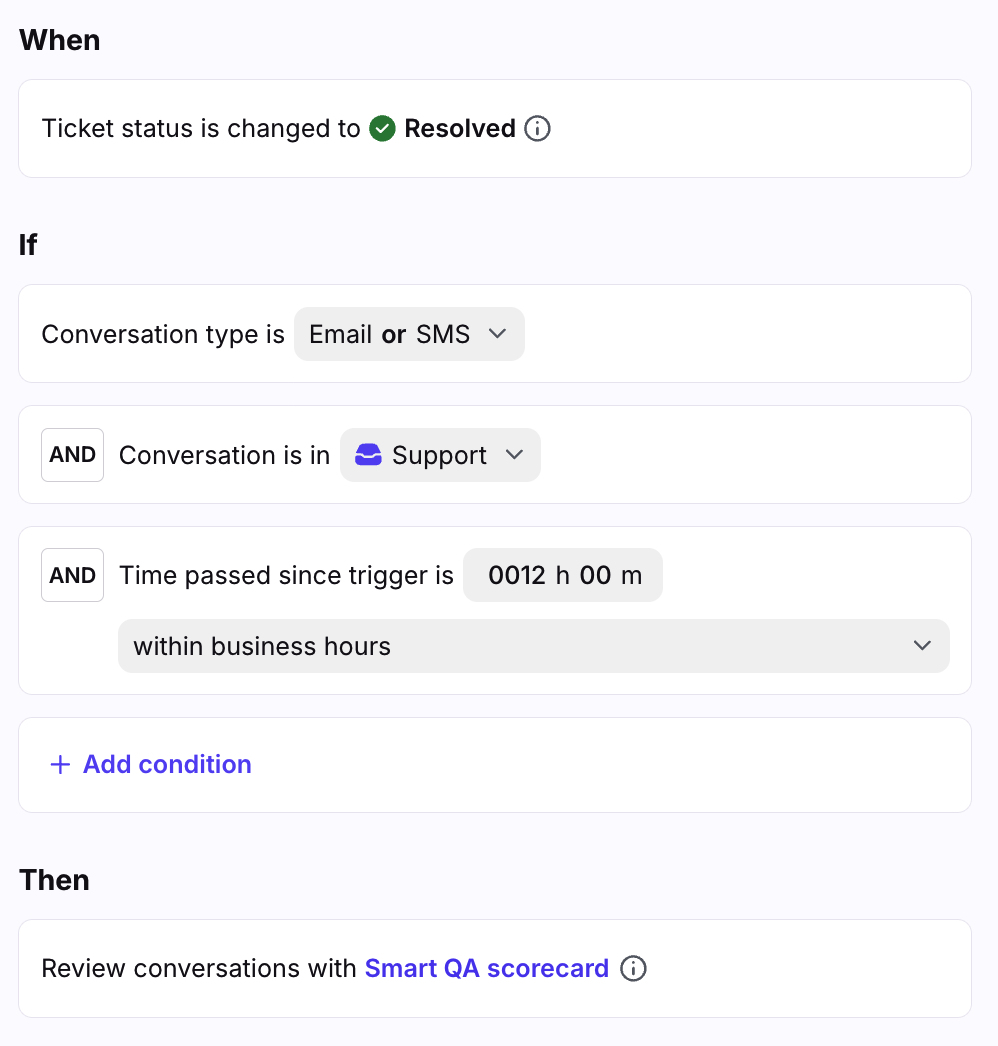
If editing a Smart QA rule, you can adjust fields like the channel types and inbox(es) this rule should apply to, the time period for the trigger, and add any additional conditions as needed.
⚠️ Important: We recommend enabling the Close conversations setting for the selected inboxes. See this article to learn how the Close conversations setting affects AI features.
Click Save when finished.
Step 5
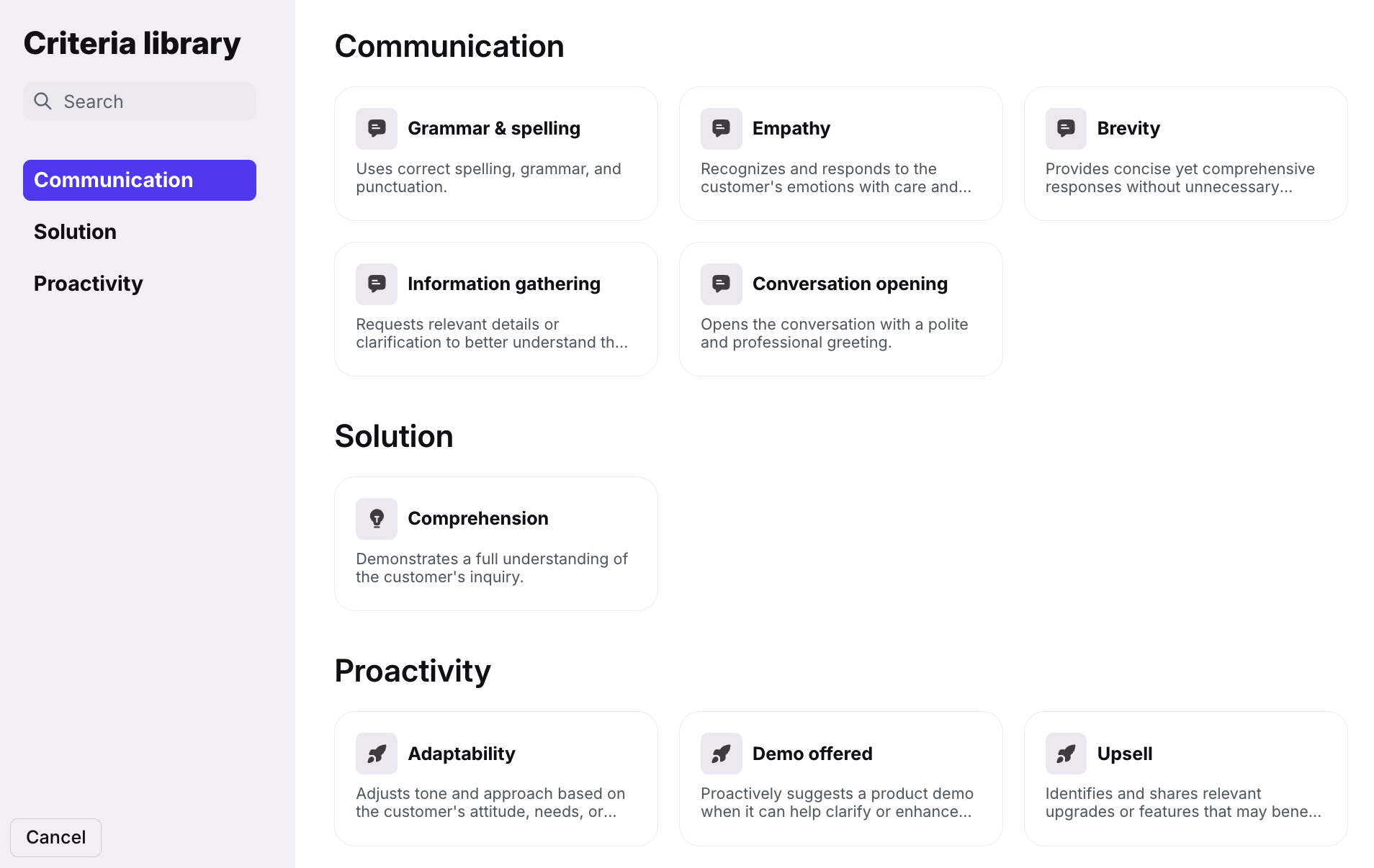
If adding new scorecard criteria, you’ll see a pop-up with a list of criteria you can add to your scorecard. Select the one you’d like to add.
Step 6
Refine the criteria fields as needed, then click Save when finished. You can return to this page at any time to edit or archive the criteria.
Reviewing QA results
Sidebar panel
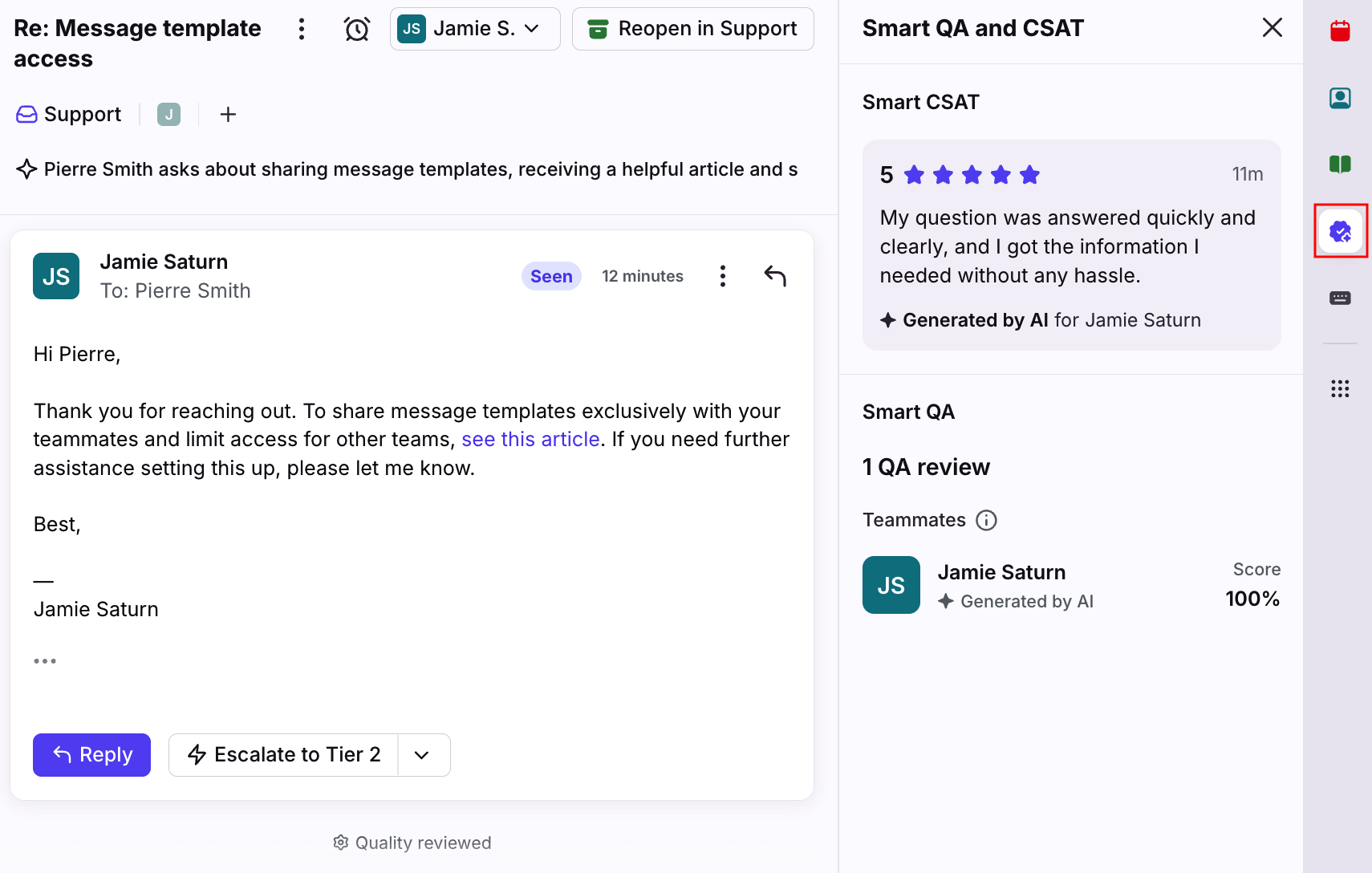
Once Smart QA is completed on a conversation, you can access the results using the Smart QA and CSAT integration in the plugin panel in the right-hand sidebar.
If you don’t see the plugin, see this article to review how to pin integrations to your sidebar.
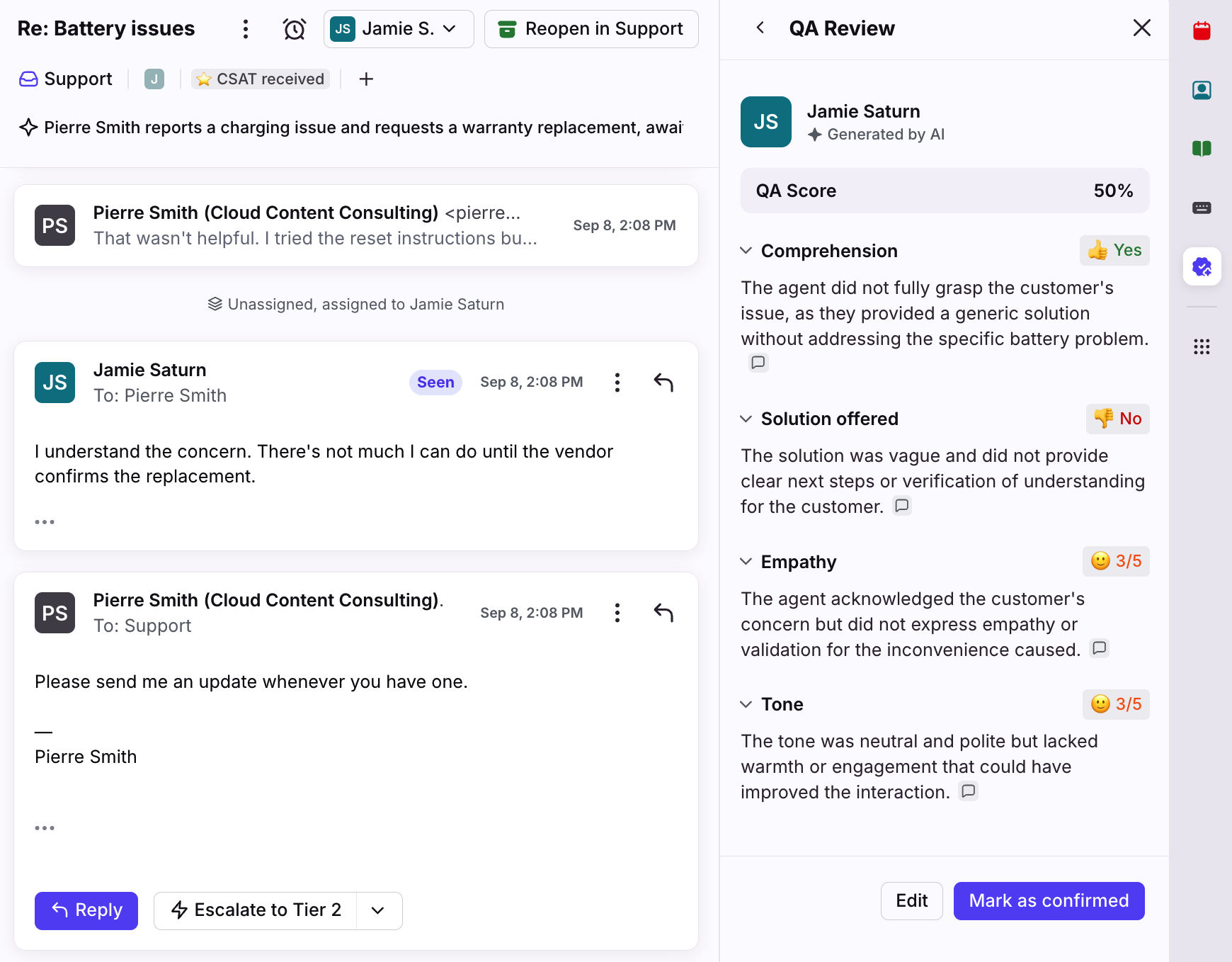
Click the review to see more details.
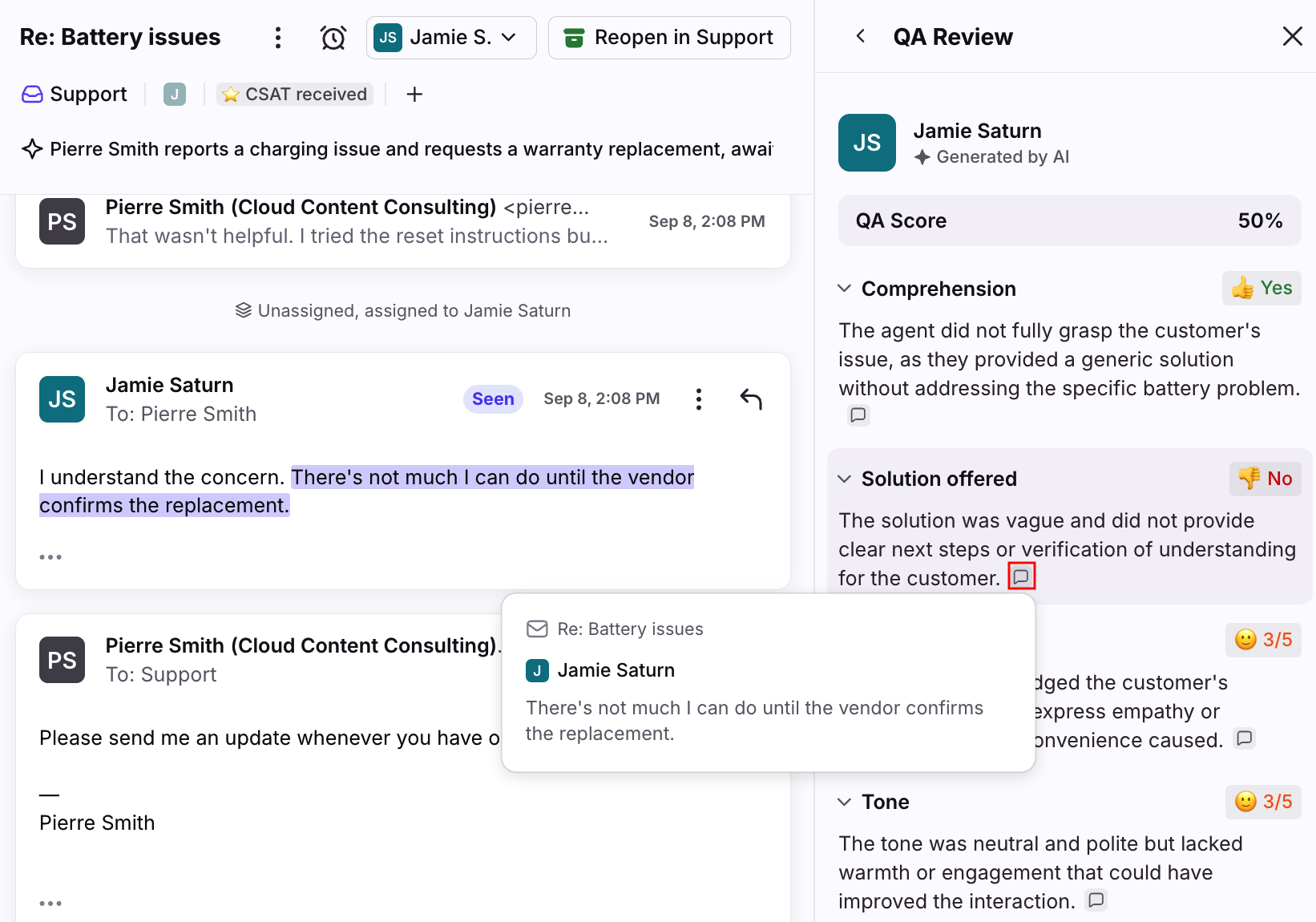
Hover over the speech balloon icon to review the message excerpt(s) used to generate the score (up to 3 excerpts). Click the citation to jump straight to the highlighted excerpt in the conversation.
Citations are available for conversations scored after Sep 6, 2026.
Analytics
In Front Analytics, admins can navigate to the Smart QA report to review team performance.
Use the dropdown menu to select which criteria to include in the report, and scroll to the right to view the rest of the table.
Select an aggregate score for a teammate to view the conversations used to calculate their results for the selected timeframe.
Use the export icon to download the aggregate scores per criteria shown in the current table view.

Select a conversation to view the QA results.

In the side panel, you can take the following actions:
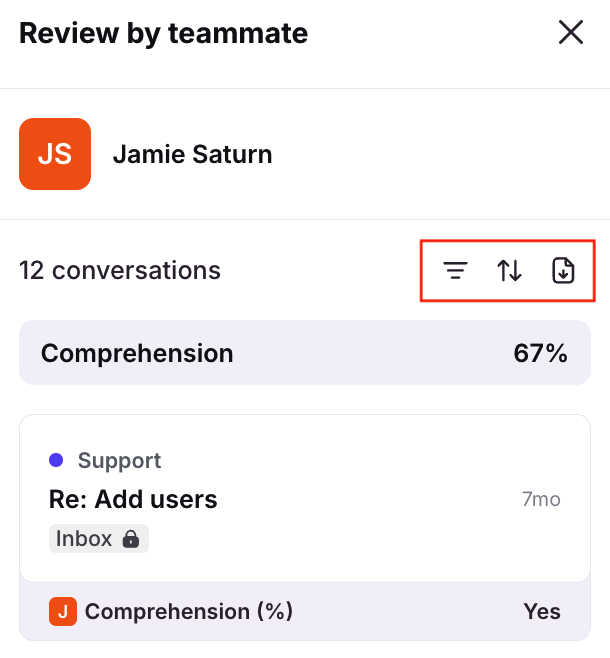
Filter: Focus on conversations based on manual review status - Confirmed, Partially confirmed, Not confirmed
Sort: Reorder the conversation list and quickly identify areas for improvement - Newest, Oldest, Highest Score, Lowest score
Export: Download a file with your metric details data
Manually overriding AI scores
Admins can manually override AI scores from both the conversation sidebar plugin and the Smart QA analytics report.
Step 1
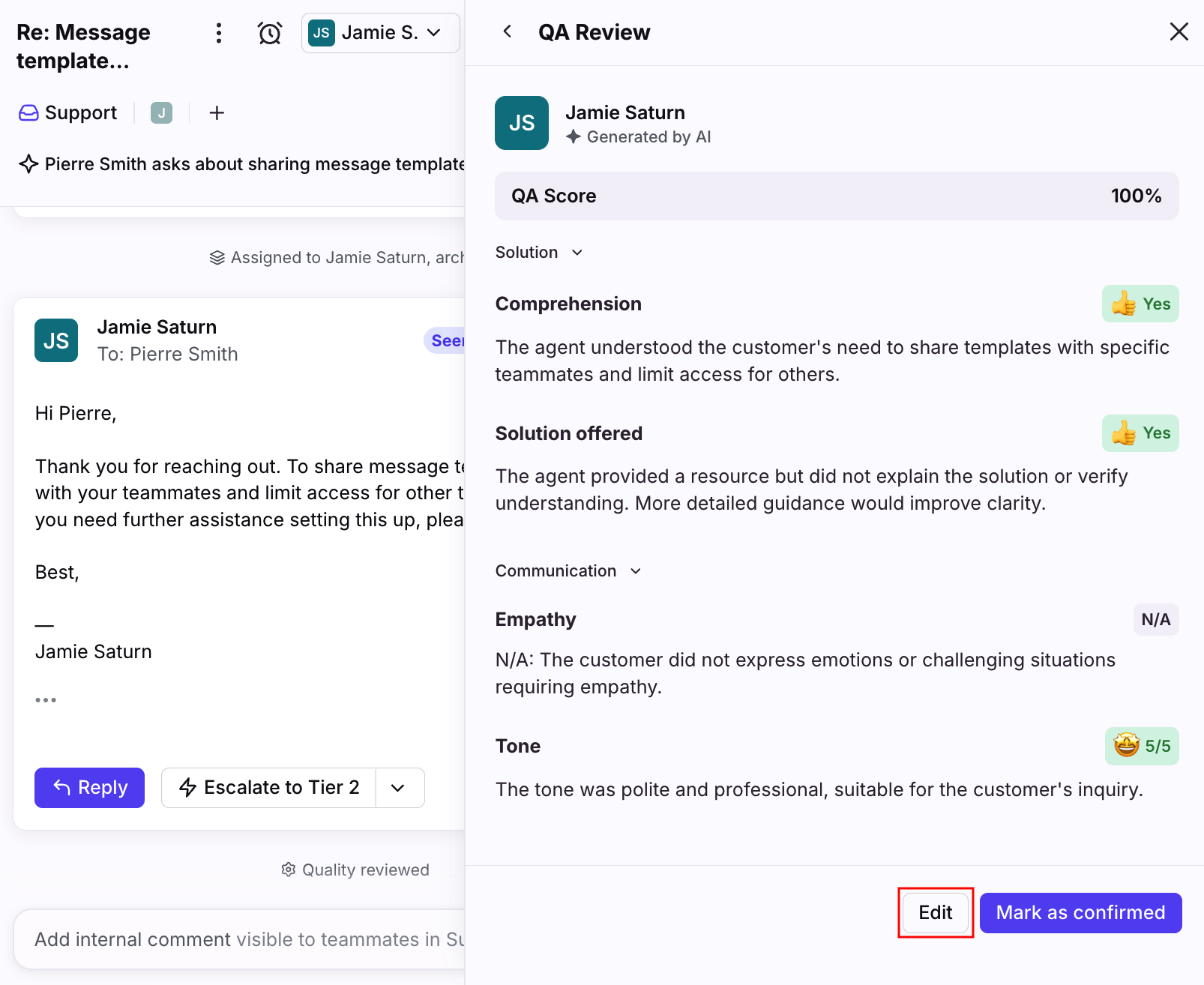
From the conversation: Navigate to the Smart QA and CSAT plugin for any conversation with an AI score.
From Analytics: In the Smart QA report, click the aggregate score for a criteria. In the sidebar panel, select a conversation.
In this example, we’ll click Edit from the sidebar panel.
Step 2
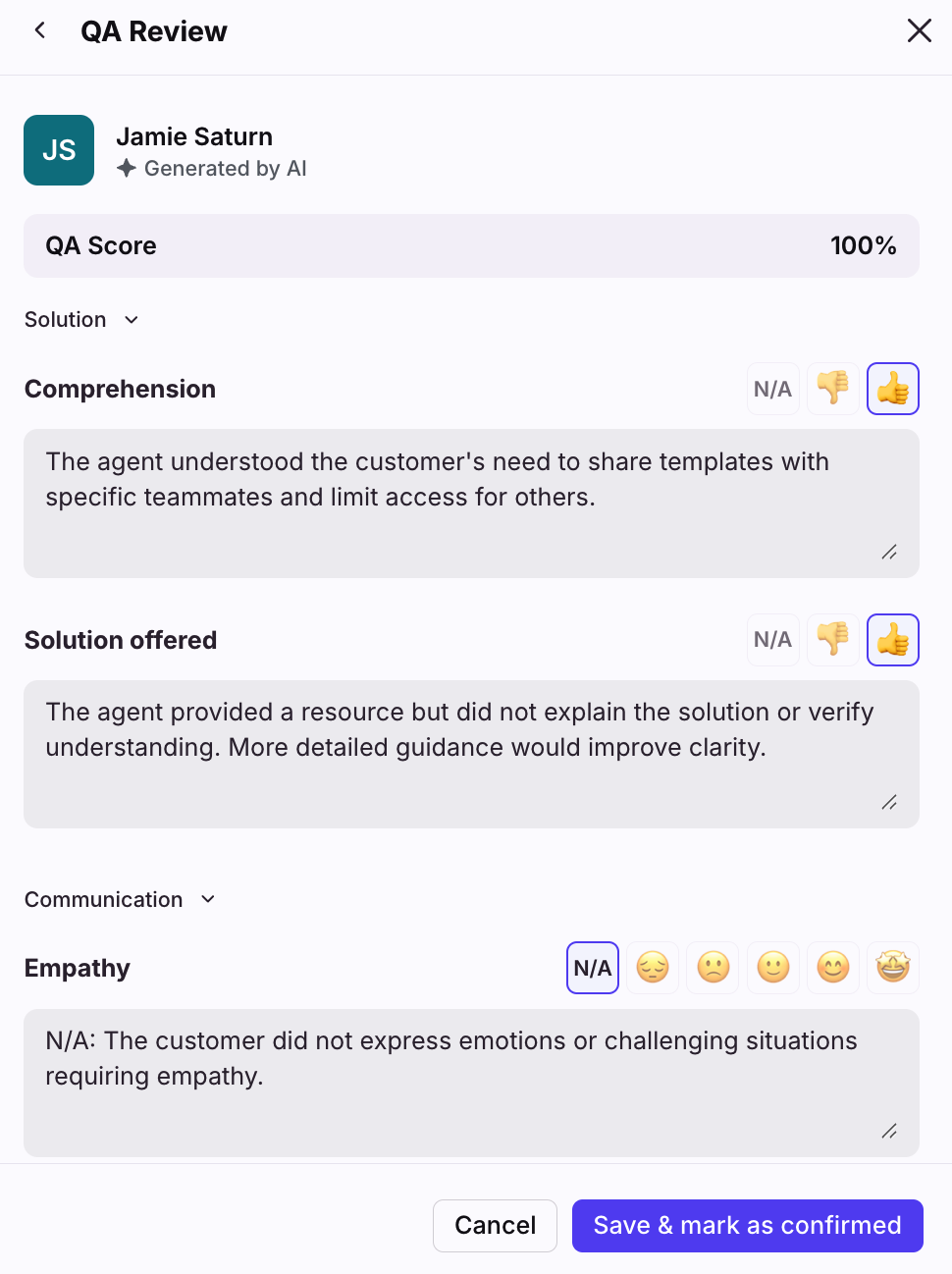
Select a scoring icon to adjust the criteria score. You can also add a comment or revise the description using the text box.
Click Save & mark as reviewed to save your changes.
Step 3
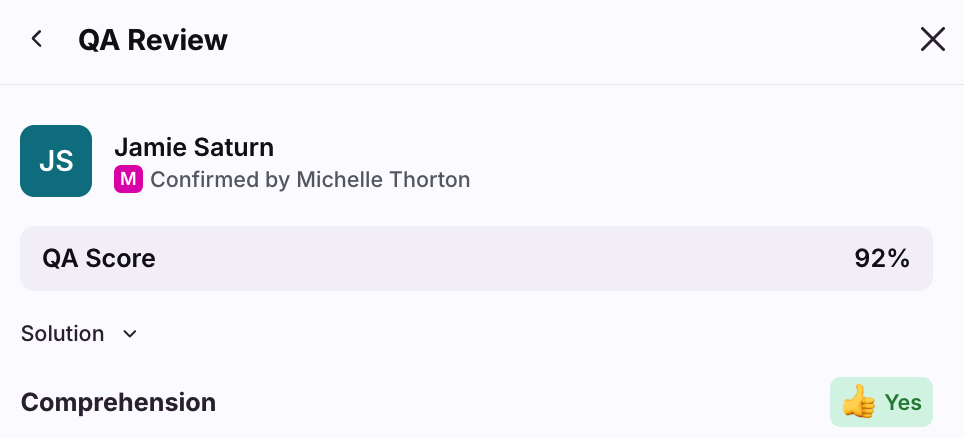
The admin's name will replace "Generated by AI" in the reviewer field. Updated scores will appear in the Smart QA report within 1 hour.
Click Edit to continue adjusting scores at any time.
FAQ
What channels are supported?
This feature is available for the following channel types: Autopilot Resolve, custom channels, email, Front Chat, Portal, SMS, Slack, WhatsApp (native), WhatsApp (via Twilio), Yalo WhatsApp.
Which languages are supported?
Only English is officially supported at this time. While it is possible to use this feature with other languages, unexpected results may occur.
Are both traditional and ticket statuses supported?
Yes. Both traditional statuses (Open/Snoozed/Archived) and ticket statuses (Open/Waiting/Resolved) are supported.
Which conversations does Smart QA review?
Only conversations in shared inboxes will be reviewed. Additionally, a conversation review requires at least one inbound and one outbound message and the conversation must be marked as Resolved or Archived. Admins can also set additional conditions during the rule setup.
To review conversations in individual (personal) inboxes, company admins can set up a mirror in inbox rule to copy these conversations into a shared inbox.
Are Smart QA rules retroactive?
No. Smart QA rules only act on conversations that have been archived/resolved after the rule has been created. They do not retroactively apply to past conversations. Similarly, when you edit a Smart QA rule, the new rule will only apply to conversations matching the criteria moving forward. New activity will need to occur on the existing conversations in order to trigger the rule.
Can I exclude certain conversations from being scored?
Yes. You can create multiple rules per workspace to trigger the QA evaluation, so you can choose which inboxes receive a scorecard or not. If these kinds of conversations are not separated by inbox, admins can manually override scorecards for those conversations.
Which agent is reviewed in a conversation with multiple agents involved?
All teammates who reply to the conversation before it is marked as Resolved/Archived are evaluated by Smart QA. Both human agents and AI Autopilot are evaluated.
Who can see the QA results?
Admins with analytics permissions can see all QA results in the Smart QA analytics report and the conversation plugin panel.
Agents can only see their own QA results in analytics and the plugin panel.
How should I interpret the QA score?
Smart QA provides an overview of team members' interactions with customers that you can see both at a glance alongside conversations or in aggregate via analytics. These scores help provide a standard measurement you can use to compare results over time or across teams.
What does the N/A score mean?
An N/A score can mean:
Smart QA didn’t detect content that meets the requirements for this criteria.
In the analytics dashboard, N/A will show for Criteria not present on the scorecard at the time of evaluation.
Can I adjust how the AI scores?
AI scoring is not customizable. e.g. Be more or less harsh. However, admins can manually override AI scoring.
Can I create multiple scorecards?
Yes. You can set up one scorecard per workspace.
Can I save my custom criteria if I’m not using “good” descriptions?
Yes. If you see indicators like “Too vague” or “Not a condition”, you can still save your custom criteria. However, we recommend using more detailed descriptions to ensure Smart QA scores your agents as expected.
How many custom criteria can I create?
You can create up to 10 custom criteria per workspace. Custom criteria are workspace-specific and cannot be shared between workspaces.
What happens if I switch the rating scale in my custom criteria?
When you switch your rating scale, any existing data will be retained, and only conversations moving forward will use the new rating scale selected for the custom criteria.
In settings:
When you switch from a 5-point scale to a binary rating, Front keeps the descriptions from the highest and lowest ratings.
When you switch from a binary rating to a 5-point scale, Front keeps the binary rating descriptions and will generate the additional three ratings.
What can custom criteria use to evaluate responses?
The evaluation uses the responses of the teammate that is being QA reviewed as the inputs for evaluation, and considers all other messages in the conversation as context. Conversation metadata such as tags, time between responses, and other information is not able to be used in the evaluation.
How accurate can we expect Smart QA to be on our data?
When it comes to factual inaccuracies, we see a general trend of 99% accuracy to the facts in a conversation being evaluated and have mitigated 99% of hallucinations.
The majority of Smart QA criteria are based on industry definitions and best practices, so their evaluations may vary slightly from individual or company assessments. In several instances we offer variations for the most subjective criteria to better align with a specific application of that criteria.
What happens to my data? Which providers does Front use?
See this article for additional AI FAQs.
Pricing
Billing information
Smart QA is included with the latest Enterprise plan at no additional cost.
Start a free trial
To try Smart QA for free, click Start free trial when hovering over the rule template. This will start a 30-day trial.