
Mirror in inbox rule template
Overview
The Mirror in inbox company rule template allows you to make conversations in individual inboxes visible in shared inboxes. The conversation is accessible in both inboxes at the same time, without completely moving the conversation out of the individual inbox. This is helpful for teams with workflows where customers directly email a specific teammate (like an account manager), but conversations also need to be visible to the entire team via a shared inbox.
Using the shared inbox, teams can then:
Respond to customers for a teammate when they are out of office
Ensure timely resolutions by leveraging time goal rules
Organize requests using ticketing or tagging
You must be a company admin to create company rules. This article assumes you know how to create Smart Rules and dynamic variables and use branching rules.
Part 1: Create rule
Step 1
Click the gear icon and navigate to company settings. Select Rules and macros in the sidebar.
Step 2
Click Create rule, then select the Mirror in inbox rule template from the rule library.
Step 3
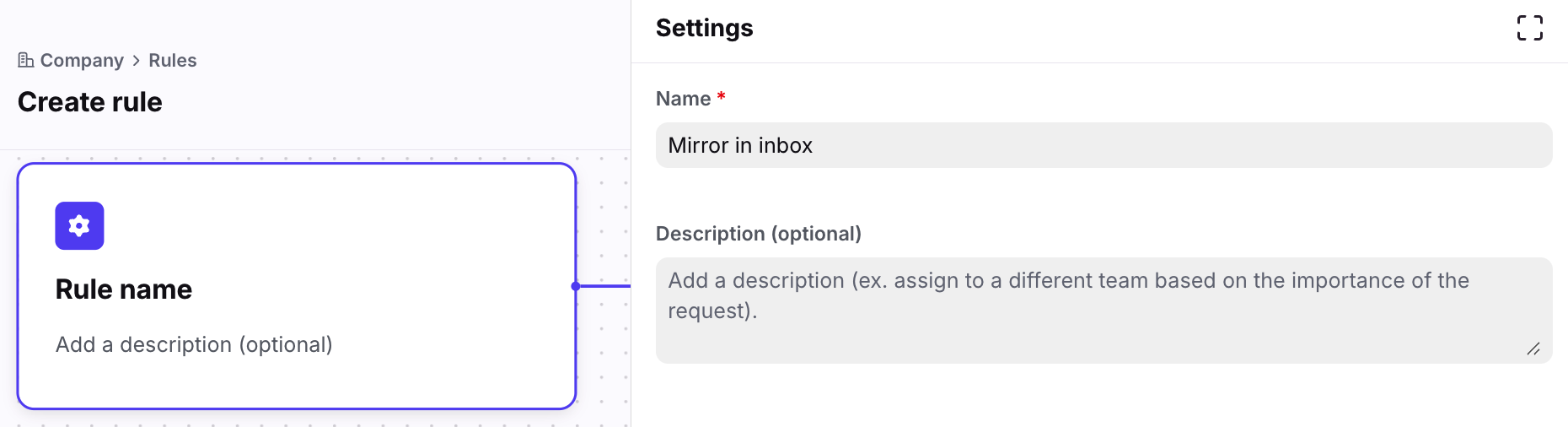
Give your rule a name, then optionally add a description. Click Save.
Step 4
In the Triggers step, add or remove any triggers depending on when you want your rule to apply. In our example rule, we want the rule to trigger on inbound messages.
Step 5
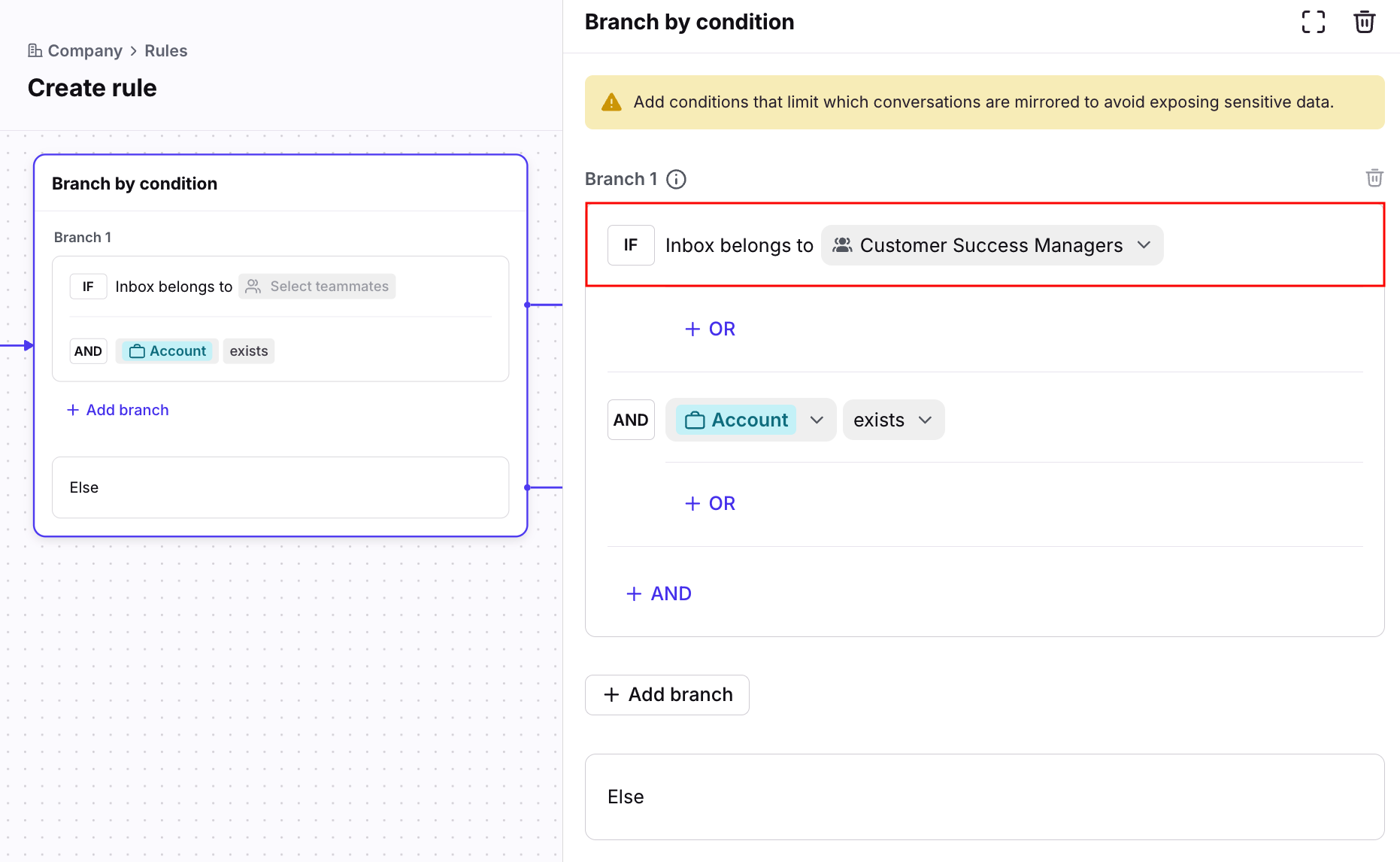
In the Branch by condition step, select the teammates the rule should apply to.
In this example, we want to mirror conversations received by teammates in the Customer Success Managers teammate group.
Part 2: Add additional conditions
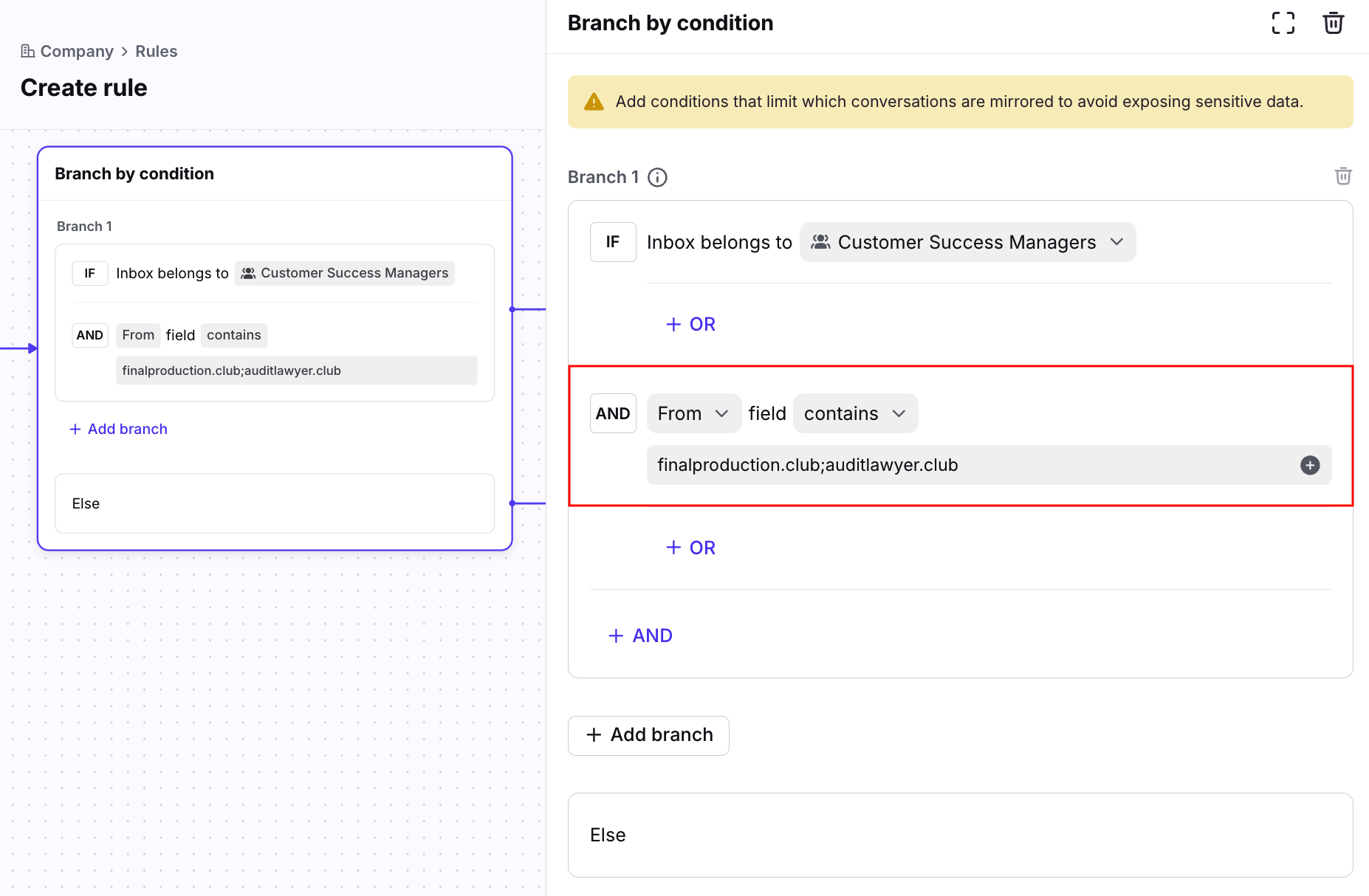
Add additional conditions to the Branch by condition step to narrow down which conversations to mirror in a shared inbox.
Example 1: Account fields
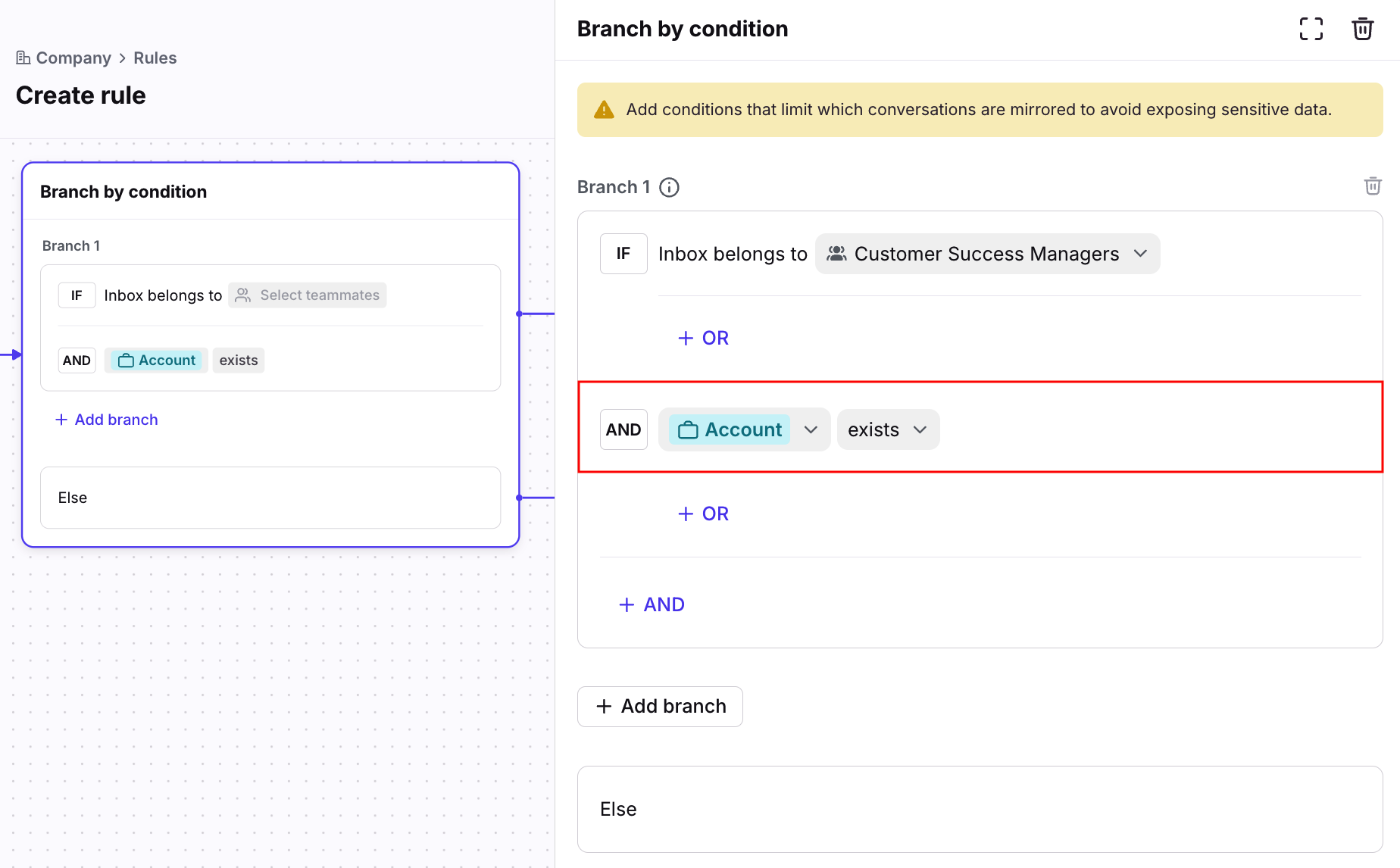
By default, the template adds the condition [Account dynamic variable] exists.
If you’ve imported account data into Front, you can use an account custom field with the condition Account custom field contains. This is useful if you have a field like “Is client?” to identify which customers should be included in your rule.
⚠️ Important to know: You must maintain accurate account records in Front for this rule to work as expected.
Example 2: Excluding domains
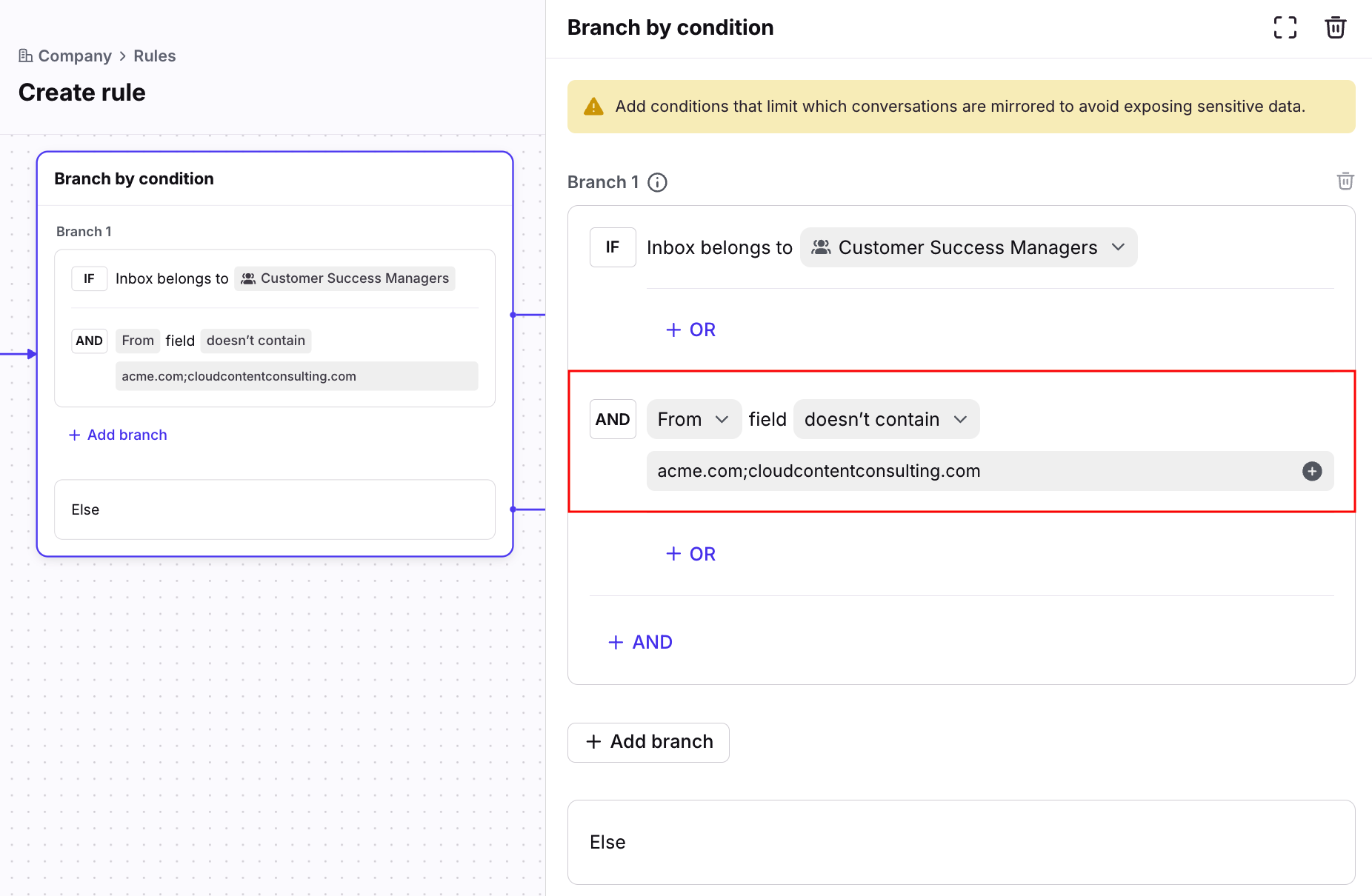
If you have a list of domains you’d like to exclude from your mirror in inbox rule, add the rule condition From field doesn’t contain [list domains]. This is useful when you need to exclude emails from:
Your internal domain
HR-related email addresses
Payroll vendor domains
⚠️ Important to know:
This list of domains needs to be manually updated when new vendors are adopted by your team.
If your domains are not identified correctly, high-risk emails will be accessible in your shared inbox.
This rule cannot differentiate between internal emails that may need to be moved to a shared inbox.
Example 3: Including domains
If you have a list of domains you’d like to include in your mirror in inbox rule, add the rule condition From field contains [list domains]. This is useful when you need to include emails from specific clients or customers.
⚠️ Important to know: This list of domains must be manually updated when there are changes to your client list.
Part 3: Finish up
Step 1
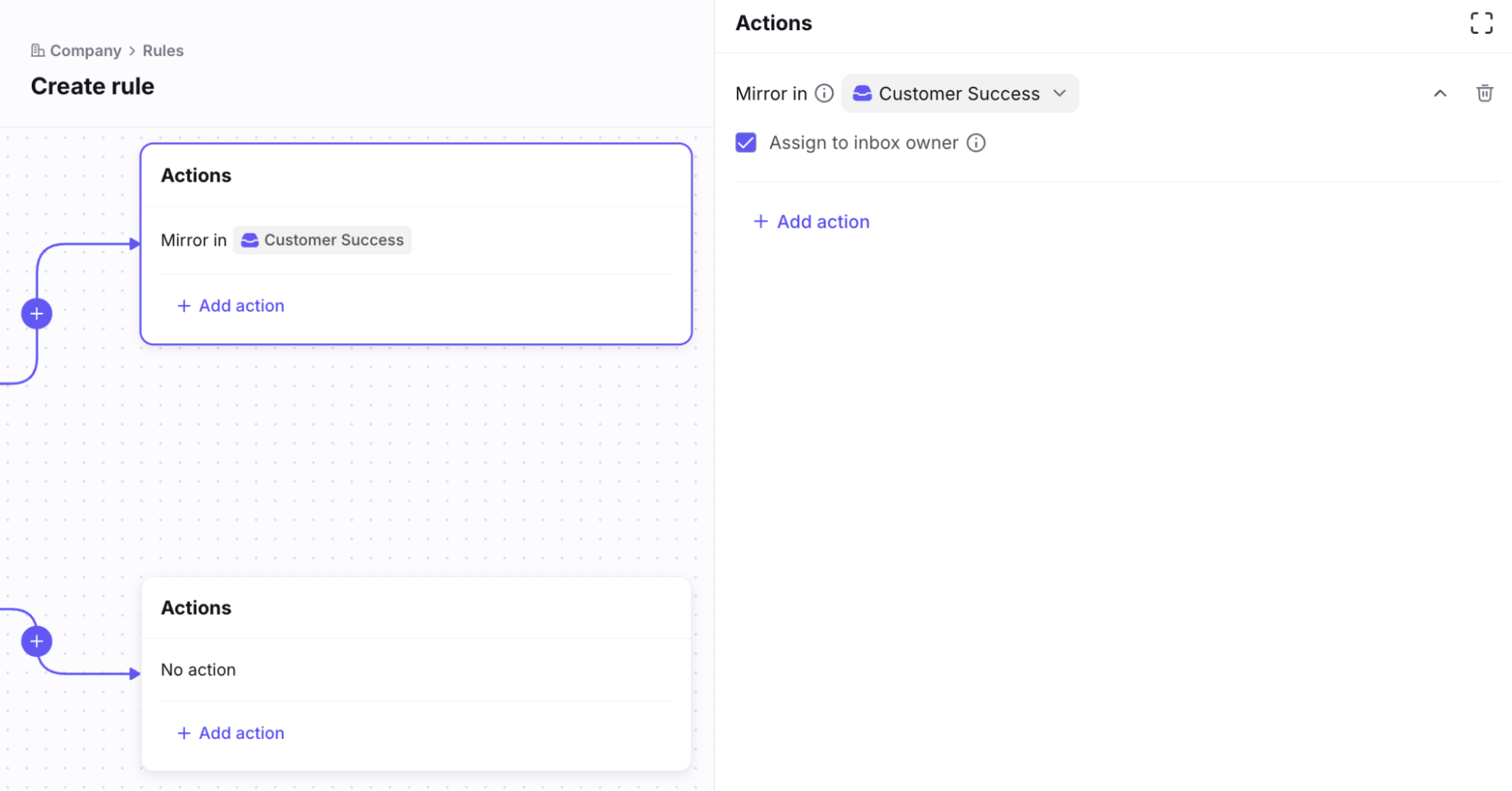
In the Actions step for Branch 1, select the inbox you’d like to mirror the conversations in. The template automatically selects the Assign to inbox owner option.
In this example, we want the conversations from the Customer Success Managers’ individual inboxes to be mirrored in the Customer Success shared inbox, then assigned to the teammate who received the original message.
Step 2
Add any additional triggers, conditions, or actions you’d like to include in your rule, then click Create to finish.
Moving forward, any new messages received in your teammates’ individual inboxes will be mirrored in your shared inbox.
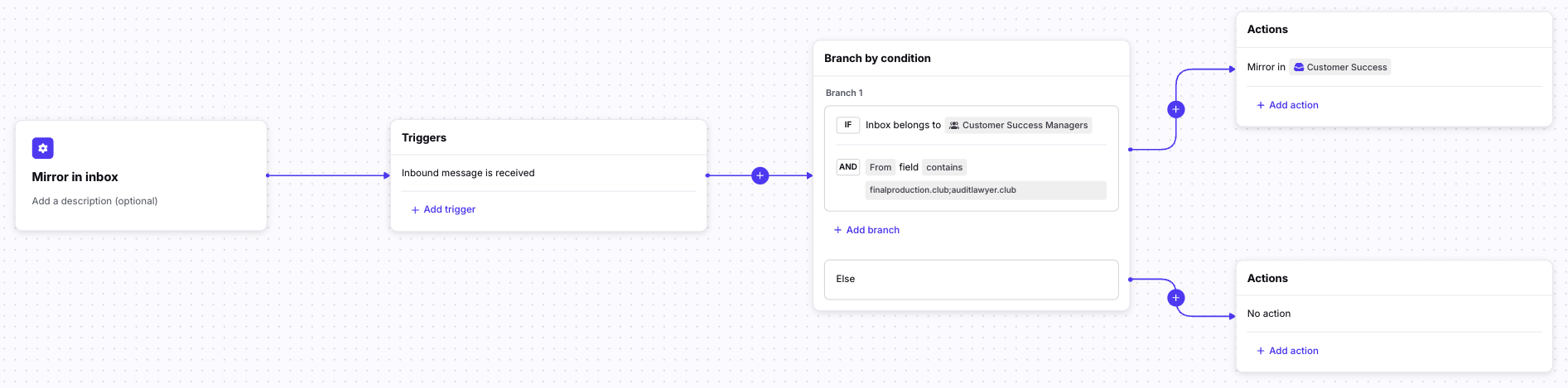
Example rule build:
FAQ
When would I use the mirror action instead of a move action?
The mirror action is more useful when you just want to grant visibility to an email, but still plan to take ownership of the conversation if you directly received it. The move action is more useful when you want true team ownership, and you care less about who received a message first.
You can achieve similar results with both mirror and move actions, but the mirror action is more appropriate when you just want to give visibility over your emails, but you don't plan to enhance the workflow or redistribute the load.
What if I archive the conversation in my individual inbox?
If your conversation is mirrored and appears in multiple individual inboxes and shared inboxes, archiving/trashing the conversation in your individual inbox does not affect the copies mirrored in the shared inboxes or another teammate’s individual inboxes.
Can I use the mirror in inbox action outside of the template?
No. The Mirror in inbox action is only available when using the mirror in inbox rule template. The rule action cannot be added to other rule templates or rules created from scratch.
Do individual (personal) rules still run on mirrored conversations?
No. Individual (personal) rules only run on conversations that remain exclusively in individual inboxes. Once a conversation is moved or mirrored to a shared inbox, individual rules are skipped.
What happens when an email is received in multiple inboxes?
Front will merge conversations if they are received in multiple inboxes at once. The mirrored conversation will be assigned to the teammate that comes first in alphabetical order.
Example: A customer sends an email that includes both sophia@acme.com and hector@acme.com. The emails are merged into one conversation, that conversation is mirrored, and the mirrored conversation in the shared inbox is assigned to Hector.
Exception: In some cases, there is a chance that emails arrive staggered by a couple minutes (i.e. Sophia gets it later than Hector). If this happens then they are treated as two entirely separate conversations.
Does this affect the conversation is moved rule trigger?
Yes. When a conversation is mirrored, it will trigger any rules with the conversation is moved trigger. The mirror in inbox action moves the conversation from inbox A to inbox B while keeping it in inbox A, allowing it to appear in both inboxes simultaneously.
Pricing
This feature is available on the Enterprise plan. Some legacy plans may have access.