
How to create a linear rule from scratch
Overview
Use rules to save time and streamline your workflows by automating tasks that you frequently perform. With Front, you have the flexibility to tailor your linear rules to meet your specific needs and preferences. This article assumes you're familiar with the following resources:
Understanding rules: Overview of Front rules and related features
Guide to rule triggers, conditions, and actions: Full list of conditions you can use to customize your rule
Front's workspace rule library: Templates for common workspace rules
Instructions
Step 1
Click the gear icon, then navigate to company, workspace, or personal settings in the left sidebar, depending on the space you’re working with.
Personal settings: The rule applies only to your individual inbox.
Workspace settings: The rule applies to the shared inboxes in that workspace. Use this for team-level automations (e.g. a shared Support inbox).
Company settings: The rule can apply across all individual and shared inboxes in the company. Use this for organization-wide automations. See this article to learn more.
Step 2
Select Rules and macros or Rules from the left menu, depending on your view. In this example, we'll create a workspace rule.
Step 3
Click Create rule, then select Create linear rule.
Step 4
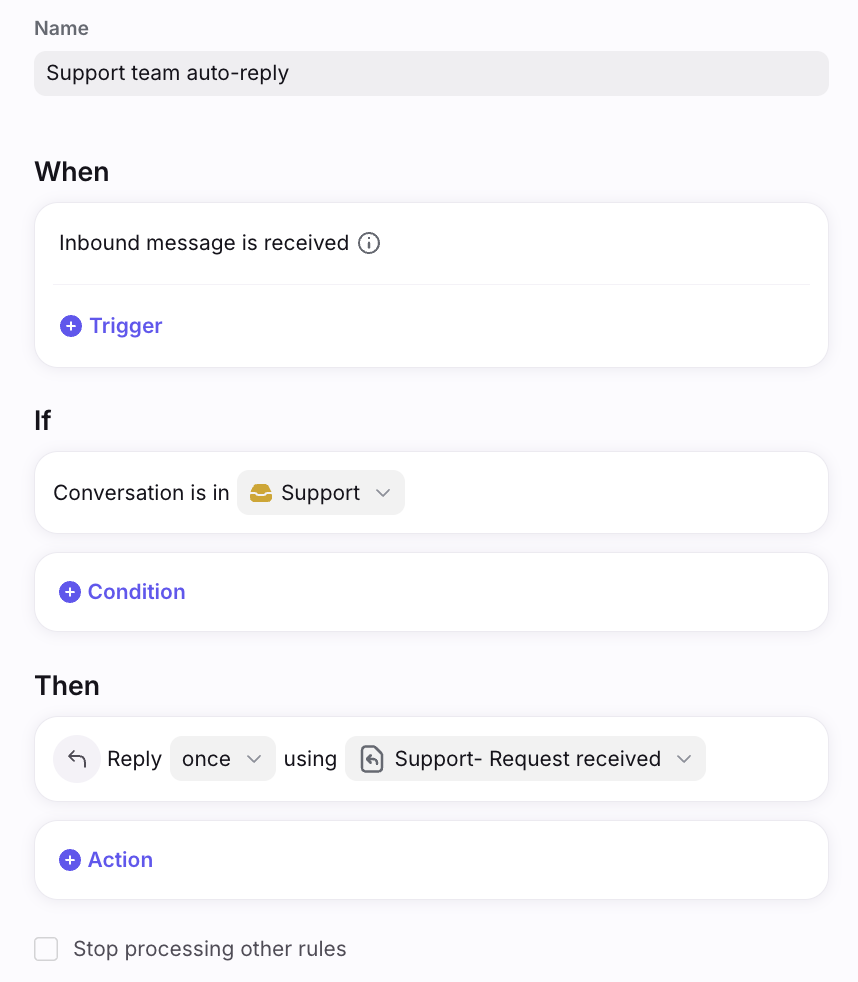
Give your rule a name, then adjust the triggers, conditions, and actions to customize the rule to your needs. The possibilities are endless for you to automate actions in your inboxes!
In this example, we want an auto-reply to be sent after we receive a support inquiry. This rule states that an inbound message into the Support inbox will be automatically replied with the message template Request received. See this article for an in-depth guide on setting up auto-replies.
Step 4
Once your rule is complete, click Create. The rule will apply to all conversations moving forward.
Rule templates
Front has rule templates to help teams discover and create rules in a few simple clicks. Use our rule library to quickly create and build rules for your team. See this article to learn more.
Pricing
Rules are available on all plans. See this article to review triggers, conditions, and actions included in each plan.